Fiber optic temperature sensing is an emerging alternative to conventional thermocouples, offering distinct advantages and some limitations. Fiber optic sensors work on the principle of photoluminescence or Raman scattering: a pulse of light is sent through an optical fiber, and the temperature is determined from the wavelength or intensity of the returned light signal. One type, the phosphorescent fiber optic sensor, uses a phosphor coating at the tip; the decay time of the phosphorescence varies with temperature. These sensors are immune to electromagnetic interference because the signal is optical, not electrical. This makes them ideal for electrically noisy environments where thermocouples suffer from EMI. They also have excellent electrical isolation, eliminating ground loop problems. They can provide extremely fast response (milliseconds) and are non-invasive. However, they have significant drawbacks for hot runner applications. First, the cost is much higher-a single fiber optic sensor can cost five to ten times more than a premium thermocouple. Second, the optical fibers are fragile and require careful handling; they cannot withstand the same level of mechanical stress (vibration, clamping, accidental pulling) as an armored thermocouple. Third, the interface-the optoelectronic converter-adds another component that can fail. Fourth, the temperature range of many fiber optic sensors is limited; while some can handle up to 400°C, the phosphor coatings can degrade over time, causing drift. Fifth, the fiber tip must be in direct thermal contact with the metal; achieving this with the same reliability as a spring-loaded thermocouple is challenging. In practice, fiber optic sensors are mostly used in research and development or in very high-value specialty applications where EMI is severe and the cost is justified. For the vast majority of industrial hot runners, thermocouples remain more practical, robust, and cost-effective. However, some hot runner manufacturers are exploring hybrid systems where a fiber optic sensor is used as a reference to periodically calibrate the thermocouple. This leverages the fiber optic's accuracy while using the thermocouple as the workhorse. Another emerging technology is distributed temperature sensing (DTS), where a single fiber optic cable along the manifold can measure temperature at every point, providing a complete thermal map. This is currently too expensive for production, but it may become feasible in the future. For now, while fiber optics offer an interesting alternative, thermocouples are expected to remain the dominant sensing technology in hot runners due to their proven reliability, low cost, and ease of installation.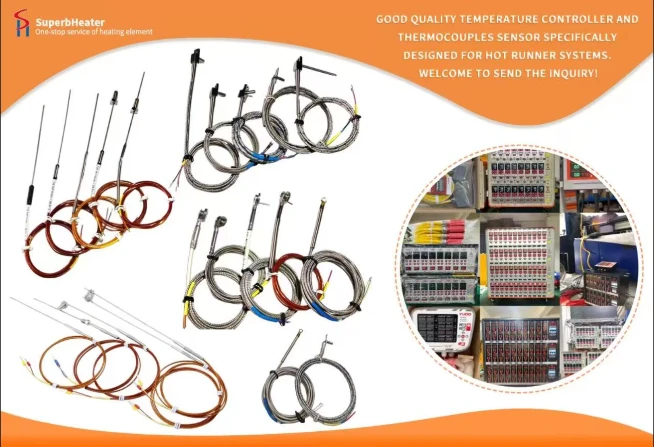

 English
- English
- Français
- Deutsch
- 日本語
- Italiano
- Español
- Português
- русский
- Indonesia
- عربي
- Ελληνικά
- Polski
- فارسی
- עברית
- Kreyòl Ayisyen
- 한국어
- Türkçe
- slovenčina
- Bai Miaowen
- Cymraeg
- dansk
- Lietuvių
- Malti
- Svenska
- Srbija jezik (latinica)
- O'zbek
- ไทย
- suomi
- magyar
- Eesti
- Català
- slovenščina
- Melayu
- Български
- اردو
- România limbi
- bosanski
- हिंदी
- Gaeilgenah Éireann
- Việt Nam
- বাংলা
- íslenska
- Norsk
- Latviešu
- hrvatski
- Nederlands
- Čeština
- українська


