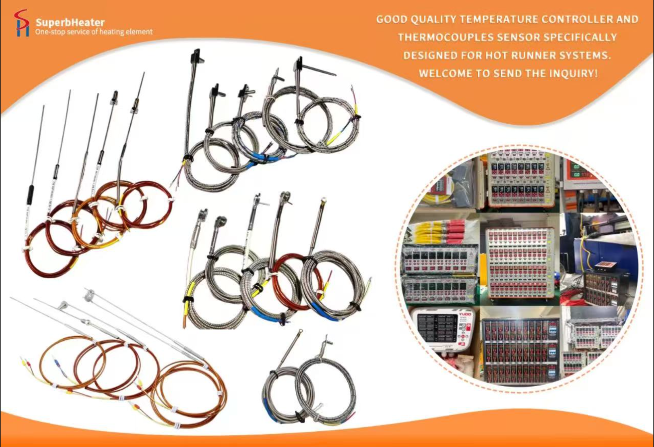
Thermocouples generate extremely low-level voltage signals, typically measured in millivolts, making them highly susceptible to electrical interference. In industrial injection molding environments, numerous sources of electromagnetic noise can disrupt these weak signals, leading to unstable temperature readings, controller oscillation, and molding defects. Understanding how electrical interference affects thermocouples is essential for designing reliable hot runner systems and troubleshooting signal issues.
Common sources of electrical interference include high-power heater cables, variable-frequency drives (VFDs), servo motors, hydraulic systems, and nearby welding equipment. Heater cables, in particular, carry large alternating currents that create strong magnetic fields. When thermocouple wires run parallel to heater cables, electromagnetic induction introduces noise into the sensor circuit. This noise appears as rapid temperature fluctuations on the controller, even when actual melt temperature remains stable.
Capacitive coupling is another form of interference. High-voltage components can induce stray voltages onto unshielded thermocouple wires. This effect is especially pronounced in compact hot runner systems where sensor cables are tightly grouped with power lines. The induced voltage distorts the thermocouple signal, causing inaccurate or unstable readings.
Ground loops, as previously discussed, create parasitic currents that interfere with thermocouple measurement. When the thermocouple circuit is grounded at multiple points with differing electrical potentials, a small circulating current flows through the sensor wires. This current adds to the thermoelectric signal, leading to consistent offset or random fluctuation.
Radio-frequency interference (RFI) from communication equipment, motor controllers, and wireless devices can also affect thermocouple signals. Although less common than magnetic interference, RFI can cause erratic behavior in sensitive temperature control systems, especially in modern factories with high digitalization.
Poor cable quality worsens interference effects. Standard unshielded wires offer no protection against electromagnetic noise. Low-quality insulation breaks down over time, allowing increased signal leakage and external interference. Only fully shielded, high-temperature thermocouple cables ensure reliable operation in noisy environments.
Improper grounding practices amplify interference. Connecting cable shields to ground at both ends creates a path for induced currents. The correct method is to ground the shield at only one point, usually at the temperature controller, to break potential ground loops.
Long cable lengths increase vulnerability to interference. Longer wires act as antennas, capturing more ambient electrical noise. In large molds, minimizing thermocouple cable length and routing them away from power sources reduces noise pickup.
Inverter-driven injection machines are particularly problematic. VFDs used to control motor speed generate significant high-frequency electrical noise. Thermocouples near these drives require extra shielding and isolation to maintain signal integrity.
Effective mitigation includes using twisted-pair shielded cables, separating power and signal routes, proper single-point grounding, and using filtered or isolated temperature controllers.
In summary, electrical interference severely disrupts thermocouple signals through induction, coupling, and ground loops. Proper wiring, shielding, and grounding are essential to maintain stable temperature control in hot runner systems.