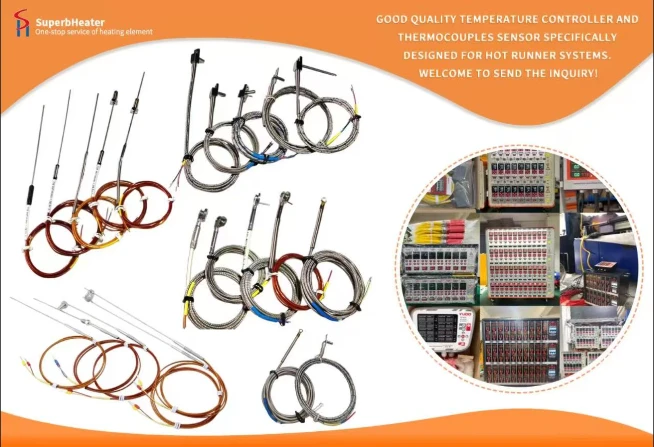
Thermocouples and controllers are intrinsically linked; the sensor's specifications determine the controller's capabilities and vice versa. When selecting a new controller, thermocouple compatibility is a primary consideration. This article explains how thermocouple characteristics influence controller selection.
Thermocouple Type Compatibility. Controllers are designed for specific thermocouple types (J, K, N, T, etc.). Some controllers support multiple types with switchable input modules. Before buying, verify that the controller accepts your existing thermocouple type. If you plan to upgrade from J to K or N, ensure the controller can be reconfigured.
Input Impedance. Controllers must have high input impedance (>1 MΩ) to avoid loading the thermocouple circuit. Low impedance causes measurement errors. Check the controller's specifications. For long cable runs (>30 m), even higher impedance (>10 MΩ) is beneficial. Some controllers specify this clearly; others do not-ask the manufacturer.
Cold-Junction Compensation (CJC). The controller's CJC accuracy is critical. It measures the temperature at the terminal block and compensates the thermocouple reading. Look for controllers with high-accuracy CJC sensors (e.g., Class A RTDs) and stable thermal design. Controllers with external CJC modules offer better accuracy than those with internal sensors exposed to draft.
Sampling Rate and Resolution. The sampling rate determines how often the controller reads the thermocouple. For fast-responding thermocouples (small diameter, grounded), a high sampling rate (≥50 Hz) is needed to capture transients. For slower sensors, 10 Hz may suffice. Resolution (e.g., 16-bit vs. 12-bit) affects temperature granularity; 0.1°C resolution is standard for hot runners.
Filtering and Noise Rejection. Controllers have built-in filters (digital or analog) to reduce noise. Adjustable filtering allows you to balance noise reduction and response speed. Look for controllers with configurable filter time constants (e.g., 0–500 ms). Also, check for 50/60 Hz noise rejection (common-mode rejection ratio >100 dB).
PID Algorithm Capability. The PID algorithm must handle the thermal dynamics of your zones. For slow manifolds, a standard PID may suffice. For fast nozzles, consider controllers with adaptive PID or feedforward capabilities. Some controllers allow separate tuning for heating and cooling, which is beneficial if cooling lines affect the zone.
Input Isolation. To prevent ground loops with grounded thermocouples, the controller should have galvanically isolated inputs (each zone electrically isolated from others and from ground). This is especially important in multi-zone systems. Check the isolation voltage rating (typically 500–1500 V).
Alarm and Diagnostic Features. The controller should detect thermocouple open circuit, short circuit, reversed polarity, and out-of-range temperatures. Advanced controllers also detect excessive drift or rate-of-change. These diagnostics prevent safety hazards and aid troubleshooting. Ensure alarms are configurable and can trigger external outputs (e.g., lights, sirens).
Communication Protocols. Modern controllers communicate with plant networks via protocols like PROFINET, EtherNet/IP, Modbus TCP, or IO-Link. If you need to integrate thermocouple data into a MES system, choose a controller with the right protocol. Also, consider controllers with built-in web servers for remote monitoring.
Power Supply Requirements. Thermocouple inputs are low-power, but the controller itself needs a stable power supply. Fluctuations in the supply voltage can affect the CJC and cause errors. Use a regulated power supply and consider a UPS for sensitive applications.
User Interface and Software. Controllers with intuitive interfaces simplify setup and troubleshooting. Look for color touchscreens, trend graphs, and zone mapping. Software tools that allow logging and exporting data are valuable for process analysis. Some controllers offer mobile apps for remote monitoring.
Scalability. If you plan to add more zones in the future, choose a controller with expansion capability (modular design). Ensure the thermocouple input modules are available and compatible with your sensor type. Scalability avoids replacing the entire system later.
Cost vs. Features. High-end controllers offer advanced features but at a higher cost. For simple molds with few zones, a basic controller is sufficient. For complex molds with many zones or critical applications, invest in features like adaptive PID, data logging, and high isolation. Evaluate the ROI of each feature.
Vendor Support. Choose a controller vendor with good technical support and local service. If you have issues with thermocouple compatibility or tuning, you need prompt assistance. Check online reviews and ask other molders for recommendations.
Case Study. A molder upgrading from old J-type sensors to K-type NIST-grade thermocouples chose a new controller with isolated inputs, adaptive PID, and Ethernet/IP communication. The combination reduced temperature variation from ±2°C to ±0.5°C and enabled real-time monitoring in the plant MES.
Final Recommendation. When selecting a controller, involve your thermocouple supplier in the discussion. They can recommend controllers that are optimized for their sensors. Alternatively, work with a system integrator who understands both controllers and sensors.