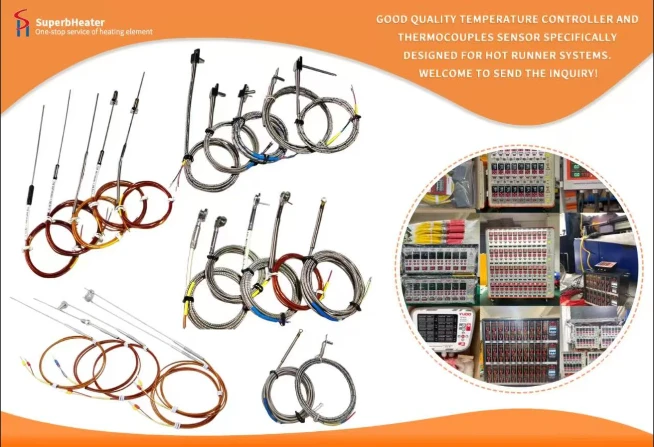
Manifolds expand significantly when heated from room temperature to operating temperature (e.g., 300°C), with linear expansion of 0.5–1.5 mm depending on length. Thermocouples must accommodate this movement without losing contact or being damaged. This article explains the interaction and provides design guidelines.
Thermal Expansion Basics. The coefficient of thermal expansion (CTE) for tool steel is about 11–13 ×10⁻⁶ /°C. For a 300 mm manifold heated from 20°C to 300°C, expansion = 300 × 280 × 12e-6 = 1.0 mm. This movement changes the relative positions of thermocouple bores and sensor tips.
Spring-Loaded Sensors. To accommodate expansion, most manifold thermocouples are spring-loaded. The spring compresses as the manifold expands, maintaining constant contact pressure. The spring travel should exceed the expected expansion (typically 2–3 mm). If the spring bottoms out, the sensor will be crushed.
Bore Design Considerations. The thermocouple bore should be aligned with the direction of expansion. If the manifold expands longitudinally, the bore should allow the sensor to slide along that axis. A bore perpendicular to expansion may cause the sensor to bend. Design bores with clearance (0.05–0.10 mm larger than probe diameter) to allow sliding.
Anchor Point Selection. In a long manifold, the thermocouple should be anchored at one end (e.g., fixed with a threaded bushing) and allowed to slide at the other. If both ends are fixed, the sensor will buckle. Standard practice: anchor the thermocouple near the center of the manifold to minimize relative motion.
Expansion-Induced Stress. If a thermocouple is rigidly clamped at two points, expansion can stretch or compress the sheath, causing cracking of the MgO insulation and eventual open circuit. Always use a floating bushing or spring at one end. Avoid rigid metal compression fittings that lock the probe.
Thermal Contact Maintenance. Expansion can also cause the thermocouple tip to lose contact with the bore wall if the bore is not deep enough. The spring ensures contact even as the manifold elongates. However, if the spring force is too high, it can indent the bore over time. Use moderate spring force (e.g., 10–20 N).
Impact on Readings. If the thermocouple loses contact due to expansion, it will read cooler than actual, causing overheating. This is a common failure mode in older molds without spring-loaded sensors. Check the spring travel and bore length during maintenance.
Material Mismatch. The thermocouple sheath (typically stainless steel or Inconel) has a different CTE than the manifold steel. Over repeated cycles, this differential expansion can cause fretting or wear at the contact point. Use a lubricant (high-temperature anti-seize) to reduce friction.
Expansion Compensation in Controllers. Some advanced controllers have algorithms that compensate for thermal expansion by adjusting PID parameters as the mold heats up. Thermocouple data during warm-up shows the expansion effect (a gradual increase in power as the manifold elongates). Use this data to optimize the warm-up profile.
Design Checklist. For new molds: specify spring-loaded thermocouples with at least 3 mm travel. Design bores parallel to the main expansion direction. Provide clearance. Anchor at the center. Use a smooth bore finish to reduce friction. During maintenance, measure the spring travel and replace if compressed beyond 80% of its range.
Case Study. A mold with fixed thermocouples (no springs) experienced repeated failures-open circuits every 3 months. FMA showed that expansion stretched the sheath, causing wire breaks. Retrofitting with spring-loaded sensors extended life to over 2 years.
Installation Procedure for Expansion. When installing, push the thermocouple into the bore until it bottoms out, then pull back 1 mm to allow for expansion. Tighten the retaining screw enough to hold but not so tight that it restricts sliding. Check the spring compression after the mold reaches operating temperature-it should be about mid-travel.
Temperature Cycles and Fatigue. Each thermal cycle causes expansion and contraction, which fatigues the thermocouple material. High cycle counts (>1 million) may require sensors with extra strain relief. Consider using a flexible armored extension between the rigid sheath and the connector to absorb movement.