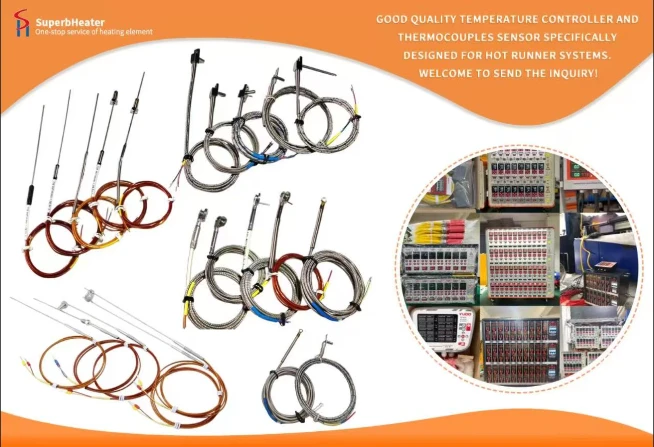
Stack molds present unique thermocouple challenges due to their moving center sections. The center plate shifts during mold opening and closing, subjecting thermocouple cables to repeated flexing and potential pinch points. Understanding these dynamics is essential for reliable temperature control in high-cavity stack mold applications.
The Stack Mold Configuration. A stack mold has two parting lines-the primary parting line on the machine side and a secondary parting line on the ejector side. The center section moves during mold opening, typically by 50–150 mm depending on the mold design. This movement requires thermocouple cables to accommodate both extension and compression without losing signal integrity.
Cable Flex Fatigue. Each mold cycle causes the center section to move, flexing the thermocouple cables. Over millions of cycles, this flexing causes conductor fatigue and insulation breakdown. Standard thermocouple cables with solid conductors fail within months; continuous-flex cables with stranded conductors are essential. Choose cables rated for at least 5 million flex cycles.
Pinch Point Hazards. The moving center section creates pinch points where cables can be trapped between mold plates. Cables must be routed through protective channels or cable carriers that guide the movement. Hardened steel conduits with smooth interiors prevent cable abrasion while allowing free movement.
Spring-Loaded Cable Management. Use spring-loaded cable reels or articulated cable carriers that maintain tension on the cables during movement. This prevents cables from sagging into pinch zones. Ensure the carrier's bending radius exceeds the cable's minimum bend radius to avoid internal wire fracture.
Thermocouple Placement in Center Section. Thermocouples in the center section's manifold must be accessible for maintenance. Design access panels or removable covers so sensors can be replaced without fully disassembling the stack. Spring-loaded probes accommodate the thermal expansion of the center manifold.
Multi-Zone Temperature Control. Stack molds typically have independent heating zones for each parting line. Each zone requires its own thermocouple. Ensure the controller has enough zones and that wiring is clearly labeled to avoid cross-connection between the two halves. Color-coded cables and connectors are essential.
Case Study: Stack Mold for Thin-Wall Cups. A plant producing thin-wall cups with a 16+16 stack mold experienced frequent thermocouple failures due to cable chafing. Installing a cable track with smooth guides and upgrading to continuous-flex cables reduced failures by 90% and improved temperature stability.
Maintenance Considerations. In stack molds, inspect thermocouple cables and carriers monthly. Look for signs of abrasion, kinking, or melted insulation. Replace cables preemptively based on flex cycle count. Document cable replacement intervals to establish predictive maintenance schedules.