Hot runner technology has revolutionized injection molding by maintaining molten plastic inside the mold cavity and eliminating cold runner waste. The entire system relies on closed-loop temperature control, and thermocouples serve as the core feedback component. Without accurate and stable temperature sensing, even the most advanced hot runner systems cannot maintain consistent thermal balance.
Modern hot runner technologies include balanced manifold design, valve gate sequential injection, multi-zone independent temperature control, and anti-leakage nozzle structures. Each function depends on real-time and precise temperature detection. Thermocouples monitor key areas including nozzle tips, manifold channels, and nozzle bodies to prevent overheating, insufficient heating, or uneven temperature distribution. Advanced thermal simulation software optimizes heater and thermocouple layout to minimize temperature deviation across multiple cavities.
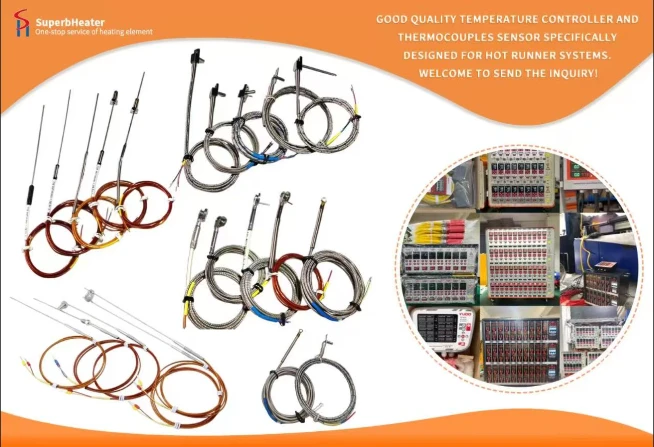
High-response thermocopues with grounded junctions provide rapid signal feedback, allowing temperature controllers to adjust power output within milliseconds. This capability is critical when processing high-temperature engineering plastics, heat-sensitive materials, and glass-filled resins. Mineral-insulated thermocouples feature excellent flexibility, pressure resistance, and thermal conductivity, enabling stable performance in narrow mold spaces.
Modern hot runner systems also integrate Industry 4.0 functions such as real-time data monitoring, fault alarm, and historical data recording. Thermocouple signals form the foundation of intelligent process control. Poor sensor performance directly leads to unstable melt pressure, inconsistent part weight, flow marks, burn marks, and other quality defects. Advanced hot runner technology significantly reduces cycle times and scrap rates, but these benefits can only be realized with reliable thermocouples.
In high-cavity molds, thermal balance determines product consistency. Each temperature zone requires an independent thermocouple to avoid differences between cavities. As molding requirements become increasingly strict, thermocouple technology continues to evolve toward miniaturization, faster response, higher durability, and stronger anti-interference. Hot runner technology and thermocouple performance are deeply integrated and mutually dependent.