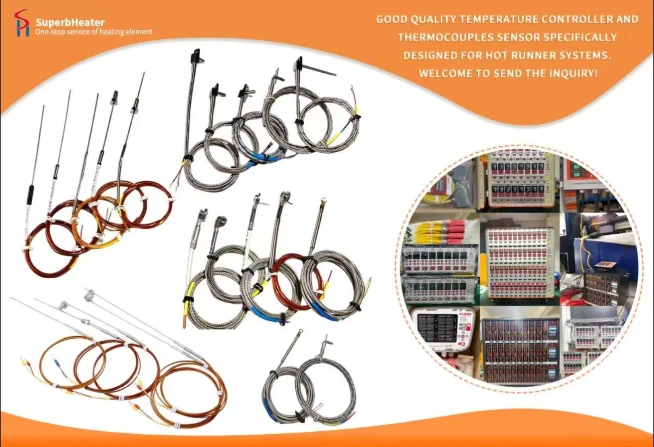
The J-type versus K-type debate is one of the most common questions in hot runner thermocouple selection. Both have advocates, both have applications where they excel, and both have limitations. Understanding the trade-offs enables better selection decisions.
The Fundamental Difference
Type J thermocouples use iron (positive leg) and constantan (negative leg). Type K thermocouples use chromel (positive) and alumel (negative). This alloy difference translates to different performance characteristics in temperature range, accuracy, oxidation resistance, and cost.
Temperature Range Considerations
Type J thermocouples are rated for -40°C to +750°C, but their practical upper limit for continuous operation is about 400°C. Above 400°C, the iron leg oxidizes rapidly, causing drift and eventual failure. Type K thermocouples are rated for -200°C to +1,200°C, with practical continuous use up to 600°C. If your processing temperature exceeds 400°C, Type K is the clear choice.
Accuracy at Operating Temperature
At moderate temperatures (200-400°C), both types offer similar accuracy-typically Class 1 (±1.5°C for J-type, ±1.6°C for K-type). But the accuracy of Type J tends to degrade faster with age because of iron oxidation. Type K also drifts, but typically slower at the same temperature. For long service life at elevated temperatures, Type K is generally superior.
Oxidation Resistance
This is the key differentiator. Type J thermocouples oxidize rapidly in air at temperatures above 400°C. The iron leg literally converts to rust. Type K thermocouples are more oxidation-resistant, with the chromel leg forming a protective oxide layer that slows further oxidation. If you're processing high-temperature engineering plastics (PEEK, PEI, LCP), Type K is the better choice.
Cost Differences
Type J thermocouples are generally less expensive because the materials are more common. Type K thermocouples use more expensive nickel-chromium alloys. The cost difference is typically 10-30%, which is usually insignificant compared to the cost of replacement labor and downtime.
Sensitivity and Output
Type J thermocouples have a higher output voltage per degree (approximately 50 μV/°C at 300°C) than Type K (approximately 41 μV/°C at 300°C). In practice, this means Type J signals are slightly less susceptible to electrical noise. This can be an advantage in electrically noisy environments.
Recommendations by Application
For packaging applications processing polyethylene or polypropylene below 250°C, Type J offers good performance at lower cost. For automotive and general engineering resins at 250-350°C, either type is acceptable, but I'd favor Type K for better long-term stability. For high-temperature engineering plastics above 350°C, Type K is the better choice. For medical or optical applications where stability is critical, Type K is generally recommended.
The Practical Reality
I've seen both types work well in hundreds of applications. The most important factor is not which type you choose but how well you maintain the sensors. A well-maintained Type J thermocouple with regular calibration will outperform a neglected Type K. That said, for new mold designs, I recommend Type K as the default choice unless there's a compelling cost or availability reason to choose otherwise.