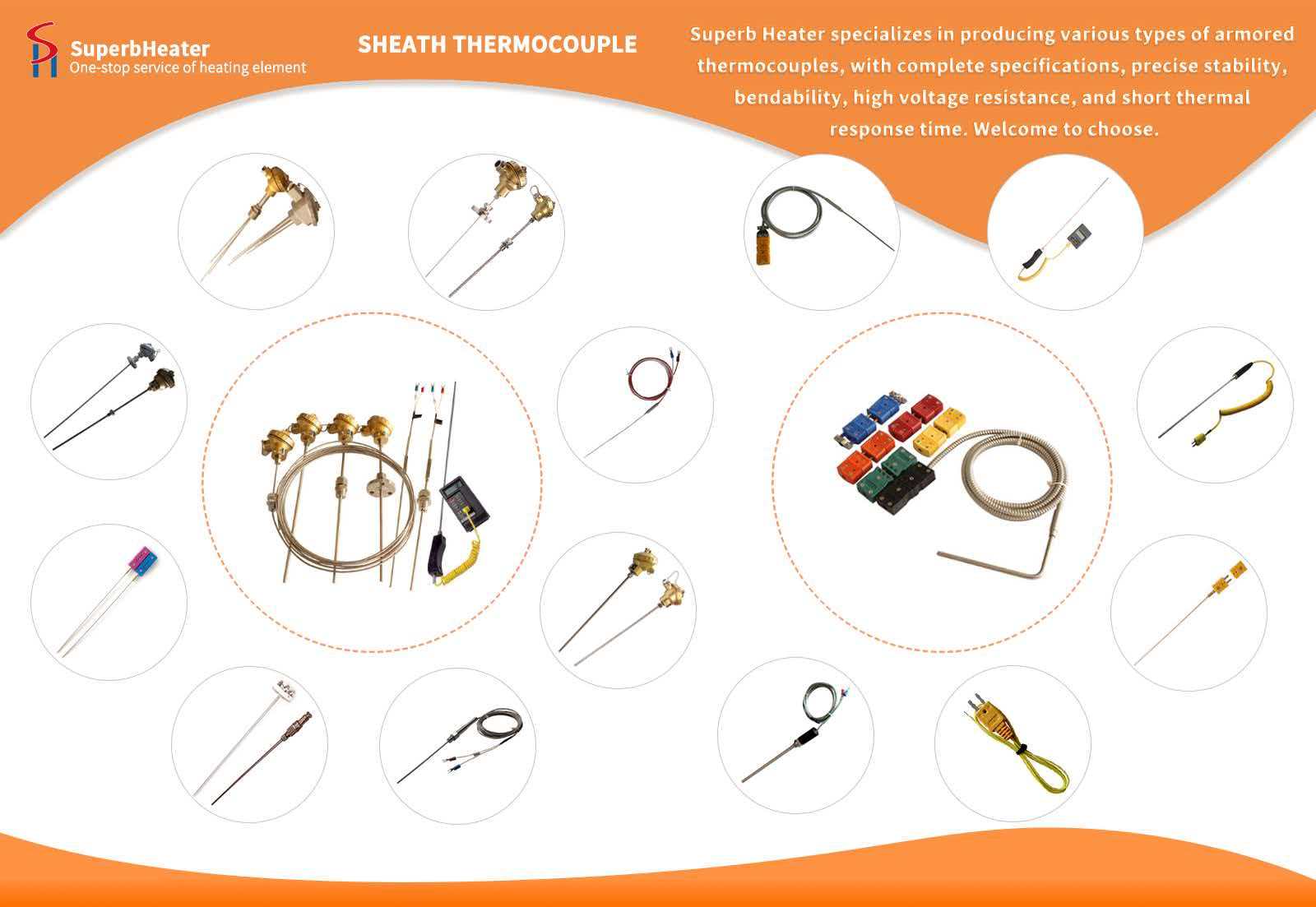
In the field of industrial temperature measurement, connection tube type probe thermocouples and Teflon-coated corrosion-resistant platinum resistance thermometers are two common types of temperature sensors. They have significant differences in structural design, working principles, performance characteristics, and application scenarios. The following provides a systematic comparison from multiple perspectives to clarify their core differences.
I. Differences in Structural Design and Installation Methods
1. Connection Tube Type Probe Thermocouple
The core feature of a connection tube type probe thermocouple lies in its connection tube fixing and bimetallic wire structure. It typically uses a metal connection tube (such as stainless steel) that is tightly attached to the surface of the object being measured. The connection tube's mechanical pressure ensures secure installation, while the interior consists of two different metal wires (such as nickel-chromium and nickel-silicon) welded together to form the measuring end. The connection tube design allows the probe to make close contact with the equipment surface, improving measurement accuracy and response speed. For example, in mechanical manufacturing or electronic equipment, the connection tube design ensures sufficient contact between the probe and the equipment surface, reducing heat loss during heat transfer. Its structural design emphasizes the tightness of the connection tube fixing and the independence of the bimetallic wires. The connection tube design reduces the influence of environmental factors on measurement accuracy and enhances resistance to mechanical shock. However, its installation process requires ensuring that the connection tube is completely in contact with the surface of the object being measured, which increases the complexity of installation. Furthermore, the bimetallic wires may oxidize in high-temperature environments, affecting long-term stability.
2. Teflon-Coated Corrosion-Resistant Platinum Resistance Thermometer
The core feature of a Teflon-coated corrosion-resistant platinum resistance thermometer lies in its Teflon sheath protection and platinum wire winding structure. It typically uses a Teflon (polytetrafluoroethylene) sheath to encase the platinum wire, providing corrosion protection through the chemical stability of Teflon. The interior consists of platinum wire wound on a ceramic or mica frame, forming the temperature-sensing element. The Teflon sheath design allows the probe to remain stable in corrosive environments such as strong acids, strong bases, or organic solvents, while also facilitating signal transmission and maintenance. For example, in the chemical or pharmaceutical industries, the Teflon sheath ensures that the probe is protected from chemical corrosion in highly corrosive media, extending its service life. The structural design emphasizes the corrosion resistance of the Teflon sheath and the stability of the platinum wire. The Teflon sheath reduces the influence of environmental factors on measurement accuracy while enhancing resistance to chemical corrosion. However, its installation requires ensuring that the Teflon sheath is in complete contact with the surface of the object being measured, which increases the complexity of installation. Furthermore, the temperature range of the Teflon sheath is relatively narrow, typically suitable for environments from -50℃ to 200℃.
II. Differences in Working Principles
1. Working Principle of Thermocouple with Connecting Tube
Thermocouples are based on the Seebeck effect, where two different metal conductors generate a thermoelectric potential difference under a temperature gradient. When two metal conductors are connected to form a closed circuit, and the two junctions have different temperatures, an electromotive force is generated in the circuit. The magnitude of this force is related to the material properties and the temperature difference between the junctions. By measuring the electromotive force, the temperature value can be indirectly calculated. Thermocouples have high sensitivity; a 1℃ temperature change results in an output potential change of approximately 5-40 microvolts. They have a simple structure with no moving parts and are suitable for high-temperature, high-pressure, and highly corrosive environments.
2. Working Principle of Teflon-Sheathed Corrosion-Resistant Platinum Resistance Thermometer
Platinum resistance thermometers are based on the characteristic that metal resistance changes with temperature. The resistance value has a non-linear relationship with temperature and requires calculation using tables or formulas (e.g., Pt100 has a resistance of 100Ω at 0℃, and the resistance value increases linearly with increasing temperature) to determine the temperature value. Platinum resistance thermometers have high sensitivity; a 1℃ temperature change results in a significant change in resistance value. They have a simple structure with no moving parts and are suitable for precise measurements at medium and low temperatures (-200℃ to 600℃), but strong magnetic fields or mechanical vibrations should be avoided to prevent affecting measurement accuracy. The addition of the Teflon sheath further expands its application range, allowing it to work stably in highly corrosive environments.
III. Identification Methods
1. Visual Inspection
Thermocouple with connecting tube: The head is usually covered with a metal protective tube, and the inside consists of two different metal wires welded together. The connecting tube part is in close contact with the surface of the object being measured.
Teflon-sheathed corrosion-resistant platinum resistance thermometer: The head is usually covered with a Teflon sheath, and the inside is a temperature-sensing element made of platinum wire. The Teflon sheath part is in close contact with the surface of the object being measured.
2. Wiring Method
Thermocouple with connecting tube: Uses a two-wire system (positive and negative), the junction box is marked "TC+" and "TC−", and the leads are usually red (positive) and black/blue (negative).
Teflon-sheathed corrosion-resistant platinum resistance thermometer: Uses a three-wire system (R1, R2, R3), the junction box is marked "R1", "R2", "R3", and the leads are usually red, white, and yellow.
3. Multimeter Measurement
Thermocouple with connecting tube: The resistance value is very small, usually only a few ohms.
Teflon-sheathed corrosion-resistant platinum resistance thermometer: The resistance value is approximately 100 ohms at room temperature (Pt100).
IV. Differences in Application Scenarios
1. Thermocouple with connecting tube
Scenarios requiring fast response and close contact: For example, in mechanical manufacturing or electronic equipment, the connecting tube design ensures sufficient contact between the probe and the equipment surface, improving measurement accuracy and response speed.
High-temperature or corrosive environments: Suitable for high-temperature, high-pressure, and highly corrosive media environments.
2. Teflon-sheathed corrosion-resistant platinum resistance thermometer
Scenarios requiring fast response and close contact: For example, in the chemical or pharmaceutical industry, the Teflon sheath design ensures sufficient contact between the probe and the equipment surface, improving measurement accuracy and response speed.
Highly corrosive environments: Suitable for environments with strong acids, strong bases, or organic solvents.
V. Selection Recommendations
1. Selection of Thermocouple with Connecting Tube Probe
Installation Requirements: Select a probe with a connecting tube specification that matches the equipment to ensure a secure connection.
Environmental Conditions: Use in scenarios requiring high-temperature or corrosive environment measurements, avoiding strong vibration or impact environments.
2. Selection of Teflon-Coated Corrosion-Resistant Platinum Resistance Thermometer
Installation Requirements: Select a probe with a Teflon coating specification that matches the equipment to ensure a secure connection.
Environmental Conditions: Use in scenarios requiring measurement in highly corrosive environments, avoiding strong magnetic fields or mechanical vibration environments.
VI. Summary and Complementary Relationship
The core difference between the thermocouple with a connecting tube probe and the Teflon-coated corrosion-resistant platinum resistance thermometer lies in their working principles and applicable environments: The thermocouple with a connecting tube probe provides flexible temperature measurement based on the Seebeck effect, suitable for scenarios requiring fast response and close contact; the Teflon-coated corrosion-resistant platinum resistance thermometer provides precise measurement at medium and low temperatures based on resistance changes, suitable for scenarios requiring fast response and close contact, and performs exceptionally well in highly corrosive environments. When selecting, it is necessary to clarify the core needs: the thermocouple with a connecting tube probe focuses on response speed and measurement accuracy in high-temperature environments, while the Teflon-coated corrosion-resistant platinum resistance thermometer focuses on response speed and measurement accuracy in highly corrosive environments. Working together, they can meet the temperature measurement needs of different scenarios.