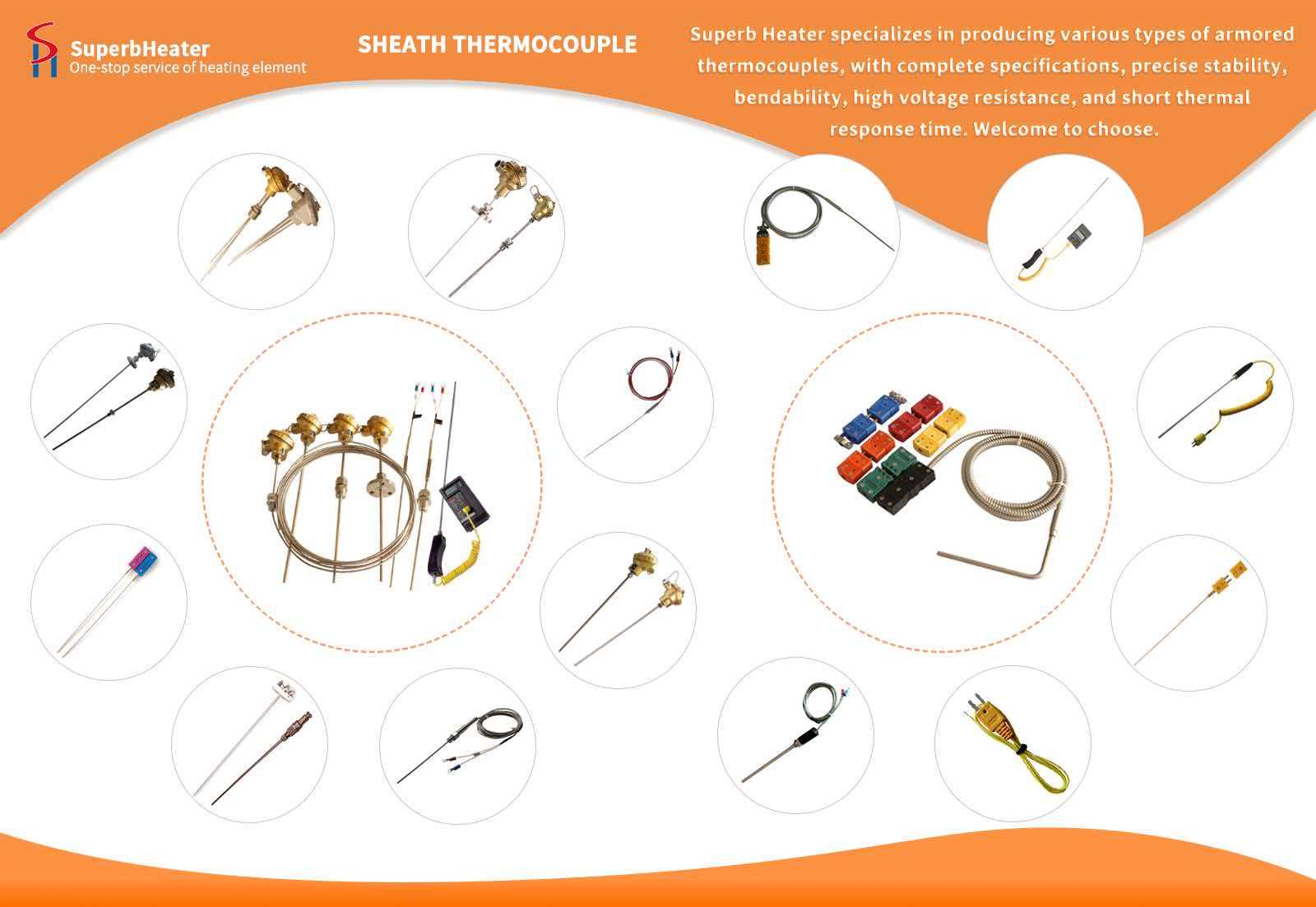
In the field of industrial temperature measurement, simple probe-type thermocouples and flat surface-mount platinum resistance thermometers are two common types of temperature sensors. They have significant differences in structural design, working principles, performance characteristics, and application scenarios. The following provides a systematic comparison from multiple perspectives to clarify their core differences.
I. Differences in Structural Design and Installation Methods
1. Simple Probe-Type Thermocouple
The core feature of a simple probe-type thermocouple is its simplified structure and direct contact design. It typically consists of two different metal wires (such as nickel-chromium and nickel-silicon) welded together to form the measuring end, with only a thin metal protective tube or insulating material covering the outside to simplify the installation process. Its structural design emphasizes rapid response and convenient installation, suitable for scenarios requiring quick deployment. For example, in the food processing or pharmaceutical industries, this design ensures that the probe can be quickly integrated into the production line, reducing downtime. However, its simplified design may sacrifice some protective performance; in high-temperature or corrosive environments, the metal wires may oxidize or corrode due to direct exposure, affecting long-term stability.
2. Flat Surface-Mount Platinum Resistance Thermometer
The core feature of a flat surface-mount platinum resistance thermometer is its flat surface design and platinum wire winding structure. It typically uses a flat metal surface (such as stainless steel) fixed to the surface of the object being measured by bolts or welding. Internally, platinum wire is wound on a ceramic or mica frame to form the temperature-sensing element, which is connected to the external circuit through a junction box. The flat surface design facilitates close contact between the probe and the surface of the object being measured, reducing heat loss during the heat transfer process. For example, in the food processing or pharmaceutical industries, the flat surface design ensures sufficient contact between the probe and the equipment surface, improving measurement accuracy and response speed. Its structural design emphasizes the close contact of the surface and the stability of the platinum wire. The flat surface reduces the impact of environmental factors on measurement accuracy and enhances resistance to mechanical vibration and shock. However, the installation process requires ensuring complete contact between the surface and the object being measured, which increases the complexity of installation, and the resistance value of the platinum wire may be affected by stress changes during long-term use.
II. Differences in Working Principles
1. Working Principle of Simple Probe-Type Thermocouples
Thermocouples are based on the Seebeck effect, where two different metal conductors generate a thermoelectric potential difference under a temperature gradient. When two metal conductors are connected to form a closed circuit, and the two junctions have different temperatures, an electromotive force is generated in the circuit. The magnitude of this force is related to the material properties and the temperature difference between the junctions. By measuring the electromotive force, the temperature value can be indirectly calculated. Thermocouples have high sensitivity; a 1°C temperature change results in an output voltage change of approximately 5-40 microvolts. Their simple structure, without moving parts, makes them suitable for high-temperature, high-pressure, and highly corrosive environments. The simple design allows for faster response times, but attention should be paid to the oxidation and corrosion of the metal wires.
2. Working Principle of Flat-End Surface Platinum Resistance Thermometers
Platinum resistance thermometers are based on the characteristic that metal resistance changes with temperature. The resistance value has a non-linear relationship with temperature and needs to be determined by consulting a table or using a formula (e.g., Pt100 has a resistance of 100Ω at 0°C, and the resistance value increases linearly with increasing temperature). Platinum resistance thermometers have high sensitivity; a 1°C temperature change results in a significant change in resistance value. Their simple structure, without moving parts, makes them suitable for precise measurements in medium and low temperatures (-200°C to 600°C), but strong magnetic fields or mechanical vibrations should be avoided to prevent affecting measurement accuracy. The flat-end surface design allows for stable measurement performance even in high-temperature environments.
III. Identification Methods
1. Appearance Inspection
Simple Probe-Type Thermocouple: The head is usually covered with a thin metal protective tube, and the inside consists of two different metal wires welded together. The metal wire part directly contacts the measured medium, and the structure is relatively simple.
Flat-End Surface Platinum Resistance Thermometer: The head is usually covered with a flat metal end surface, and the inside contains a temperature-sensing element made of wound platinum wire. The end surface is fixed to the surface of the object being measured by bolts or welding, and the junction box is used to connect to the external circuit.
2. Wiring Method
Simple Probe-Type Thermocouple: Uses a two-wire system (positive and negative), the junction box is marked "TC+" and "TC−", and the leads are usually red (positive) and black/blue (negative). Flat-type surface-mount platinum resistance thermometer: Uses a three-wire system (R1, R2, R3), with the junction box marked "R1," "R2," and "R3," and the leads are usually red, white, and yellow.
3. Multimeter Measurement
Simple probe-type thermocouple: The resistance value is very small, usually only a few ohms.
Flat-type surface-mount platinum resistance thermometer: The resistance value is approximately 100 ohms at room temperature (Pt100).
IV. Differences in Application Scenarios
1. Simple Probe-Type Thermocouple
Scenarios requiring fast response and direct contact: For example, in the food processing or pharmaceutical industries, the simple design ensures that the probe quickly senses changes in the medium temperature, improving measurement efficiency.
High-temperature environments: Performs stably in high-temperature measurements, suitable for high-temperature equipment such as reactors and pipelines.
2. Flat-Type Surface-Mount Platinum Resistance Thermometer
Scenarios requiring fast response and close contact: For example, in the food processing or pharmaceutical industries, the flat surface design ensures full contact between the probe and the equipment surface, improving measurement accuracy and response speed.
Medium and low-temperature environments: Performs excellently in indoor or low-pressure scenarios, such as HVAC systems.
V. Selection Suggestions
1. Simple Probe-Type Thermocouple Selection
Environmental conditions: Use in scenarios requiring fast response and direct contact with the medium being measured, avoiding strong vibration or impact environments.
Installation requirements: Select a probe with a measurement end specification that matches the equipment to ensure a secure connection.
2. Flat-Type Surface-Mount Platinum Resistance Thermometer Selection
Installation requirements: Select a probe with a flat surface specification that matches the equipment to ensure a secure connection.
Environmental conditions: Use in scenarios requiring precise measurement and fast response in medium and low-temperature environments, avoiding strong magnetic fields or mechanical vibration environments. VI. Summary and Complementary Relationship
The core difference between the simple probe-type thermocouple and the flat-surface platinum resistance thermometer lies in their working principles and applicable environments: The simple probe-type thermocouple utilizes the Seebeck effect to provide flexible temperature measurement, suitable for scenarios requiring fast response and direct contact, and performs particularly well in high-temperature environments; the flat-surface platinum resistance thermometer uses resistance changes to provide precise measurement in medium and low-temperature ranges, suitable for scenarios requiring fast response and close contact, and exhibits stable performance, especially in high-temperature or vibrating environments. When selecting a sensor, it is necessary to clarify the core requirements: the simple probe-type thermocouple focuses on response speed and measurement efficiency in high-temperature environments, while the flat-surface platinum resistance thermometer focuses on response speed and measurement accuracy in medium and low-temperature environments. Working together, these two types of sensors can meet the temperature measurement needs of different scenarios.