Evaluating the performance of a thermocouple after installation is an essential step to verify that it is correctly installed, properly functioning, and providing accurate data. The evaluation process begins immediately after installation, before the hot runner is heated. Perform a continuity test using a multimeter set to resistance. The reading between the two leads should be less than 5 ohms for a short probe; if it is infinite, the thermocouple is open. Also, measure the insulation resistance between each lead and the sheath using a megohmmeter at 500V; values should exceed 100 MΩ. If the insulation is low, the sensor may have been damaged during installation. Next, heat the hot runner to the standby temperature (e.g., 150°C) and observe the controller's reading. It should increase smoothly and stabilize at the setpoint within a reasonable time (typically 10–15 minutes for a manifold). If the reading jumps erratically or stabilizes at an incorrect value, the thermocouple may be loose or damaged. After stabilization at standby, perform a "temperature comparison" test. Using a surface pyrometer or a contact thermocouple placed near the sensor's location on the outside of the mold, compare the temperature reading. A difference of more than ±2°C warrants further investigation. Then, increase the setpoint to the full operating temperature. Monitor the overshoot-a properly tuned PID loop with a good thermocouple should have an overshoot of less than 5°C and settle within 5 minutes. If the overshoot is excessive or the temperature oscillates, the thermocouple may be too slow, or the PID parameters need adjustment. Once stabilized at the operating setpoint, perform a "step change" test: increase the setpoint by 10°C and record the time for the temperature to reach 90% of the new value. This is the response time. If it exceeds the manufacturer's specification, the thermal contact may be poor or the probe may be too large. Next, check the repeatability by setting the temperature back to the original setpoint and verifying that the reading returns to within ±0.5°C. Finally, run a short production trial (e.g., 100 cycles) and monitor the temperature stability cycle to cycle. A stable thermocouple should show no more than ±0.5°C variation from one cycle to the next. If the temperature drifts during production, the sensor may be picking up ambient changes or the CJC may be faulty. Document all evaluation results-these become the baseline for future trend monitoring. If the thermocouple fails any of these tests, it should be replaced before production begins. This post‑installation evaluation is a quality assurance step that prevents process‑related issues and ensures that the hot runner will perform as designed from day one.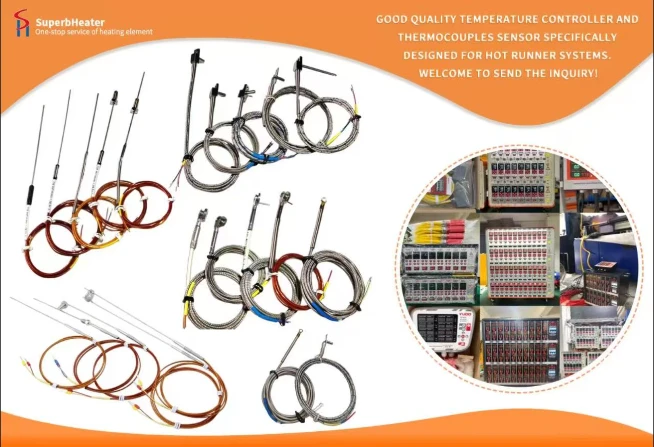

 English
- English
- Français
- Deutsch
- 日本語
- Italiano
- Español
- Português
- русский
- Indonesia
- عربي
- Ελληνικά
- Polski
- فارسی
- עברית
- Kreyòl Ayisyen
- 한국어
- Türkçe
- slovenčina
- Bai Miaowen
- Cymraeg
- dansk
- Lietuvių
- Malti
- Svenska
- Srbija jezik (latinica)
- O'zbek
- ไทย
- suomi
- magyar
- Eesti
- Català
- slovenščina
- Melayu
- Български
- اردو
- România limbi
- bosanski
- हिंदी
- Gaeilgenah Éireann
- Việt Nam
- বাংলা
- íslenska
- Norsk
- Latviešu
- hrvatski
- Nederlands
- Čeština
- українська


