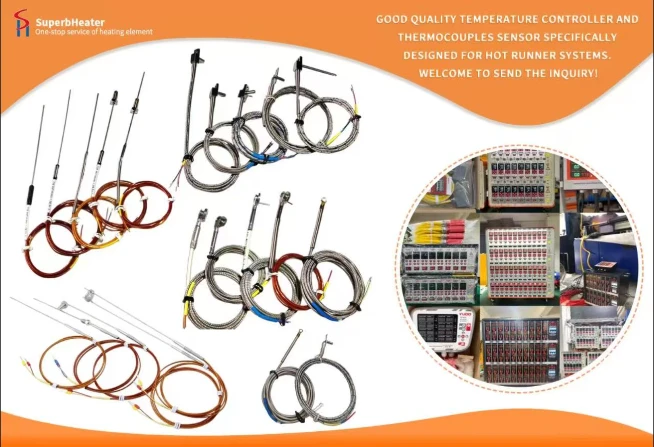
Thermocouples have a finite service life. Identification of early aging signs and establishment of a replacement schedule are effective measures to avoid sudden failure. This article provides practical criteria for recognizing when replacement is necessary.
Key Aging Indicators. Aging manifests through: continuous output drift-the displayed temperature gradually deviates from setpoint despite stable process conditions; increased signal noise-random temperature jumps of 1–3°C; slow response-the sensor takes longer to reach stable temperature after setpoint changes; and physical changes-sheath discoloration, oxidation, or deformation.
Drift as a Primary Sign. Regular calibration reveals drift. If drift is trending toward the sensor's tolerance limit (typically ±2°C for Class 1), plan replacement. In one documented case, thermocouple drift caused an 8.5°C temperature discrepancy at end nozzles, reducing yield from 99.3% to 94%. This illustrates the economic impact of ignoring drift.
Visual Inspection Indicators. During routine maintenance, inspect for: darkening (oxidation), pitting (chemical attack), flattening or scoring (mechanical damage), and any deformation of the sheath. Any visible damage warrants replacement, even if the sensor still reads correctly.
Resistance and Insulation Checks. A gradual increase in loop resistance (e.g., from 5 Ω to >15 Ω) indicates internal oxidation. Insulation resistance below 10 MΩ at room temperature indicates moisture ingress or insulation breakdown. Both conditions justify immediate replacement.
Establishing Replacement Intervals. Based on application and historical performance, set maximum service life limits. For high-temperature zones (>350°C), replace every 6–8 months. For standard zones, 12–14 months is typical. Replace proactively based on service life, not wait for failure.
Case Study: PET Preform Molding. In PET preform production, thermocouple aging caused incremental yield deterioration. By establishing an 8-month replacement schedule, a preform molder reduced scrap rates by 30% and improved production stability.
Data Logging Supports Prediction. Use controller data logging to track temperature offsets over time. Predictive algorithms can identify when drift rate accelerates, signaling end-of-life. This enables scheduled replacement rather than emergency response, reducing downtime costs by up to 80%.