The dynamic response of a thermocouple-how quickly it reacts to a change in temperature-is a critical but often overlooked parameter that directly influences the controller's ability to maintain stability. A slow thermocouple introduces a time delay in the feedback loop, causing the controller to overcorrect, which leads to temperature oscillations (hunting). A fast thermocouple allows the controller to respond promptly, reducing overshoot and settling time. The response time is characterised by the time constant (τ), defined as the time required for the sensor to reach 63.2% of a step change in temperature. For hot runner thermocouples, typical time constants range from 0.1 seconds (very fast, thin grounded junction) to 3 seconds (slower, ungrounded thick sheath). To optimise response, several factors can be managed. First, the junction type: grounded junctions are faster because the measuring tip is in direct contact with the sheath, which contacts the mould metal. Ungrounded junctions have a layer of insulation between the wires and the sheath, adding thermal resistance. If speed is paramount, choose grounded, but ensure the controller has isolated inputs to avoid ground loops. Second, probe diameter: smaller diameter means less thermal mass and faster response. A 0.5 mm probe can be three times faster than a 1.5 mm probe of the same type. However, smaller probes are more fragile and have higher electrical resistance, so a trade-off exists. Third, the fit in the mounting hole: a tight fit (minimal air gap) maximises heat transfer, whereas a loose fit slows response. Use a thermal paste if the fit is loose, but avoid excessive amounts that can act as insulation. Fourth, the controller's filter setting: a heavy filter (long time constant) slows the effective response. Reduce the filter to the minimum that still rejects noise. Many controllers offer a "response time" parameter that adjusts the filter and the PID algorithm. Fifth, the position of the thermocouple relative to the heater: placing the sensor closer to the heater reduces the distance heat must travel, improving response. However, if placed too close, it may cause overshoot. The optimal location is between the heater and the melt channel. To optimise response for a specific mold, conduct a step test: change the setpoint by 10°C and record the time for the reading to stabilise. If the time is longer than desired, consider a faster thermocouple or adjust the mounting. In high-cycle applications (e.g., packaging), response times below 0.5 seconds are often required. Some manufacturers offer "fast-tip" designs with an exposed junction for ultra-fast measurement, but these are more susceptible to mechanical damage. In summary, optimising dynamic response is a balancing act between speed, robustness, and noise immunity. By understanding these factors, process engineers can select and install thermocouples that provide the best possible feedback for their controller, resulting in tighter temperature control and higher part quality.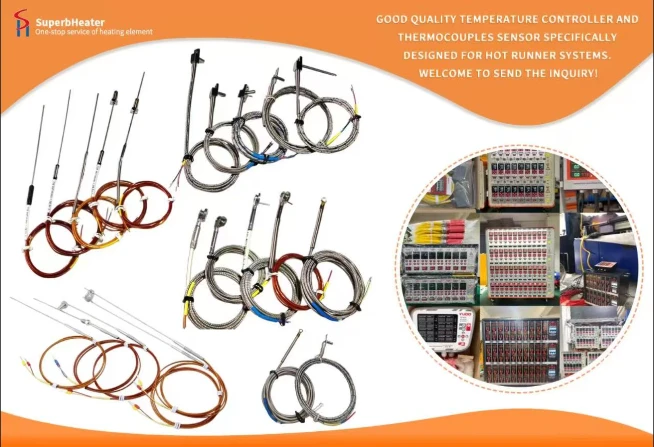

 English
- English
- Français
- Deutsch
- 日本語
- Italiano
- Español
- Português
- русский
- Indonesia
- عربي
- Ελληνικά
- Polski
- فارسی
- עברית
- Kreyòl Ayisyen
- 한국어
- Türkçe
- slovenčina
- Bai Miaowen
- Cymraeg
- dansk
- Lietuvių
- Malti
- Svenska
- Srbija jezik (latinica)
- O'zbek
- ไทย
- suomi
- magyar
- Eesti
- Català
- slovenščina
- Melayu
- Български
- اردو
- România limbi
- bosanski
- हिंदी
- Gaeilgenah Éireann
- Việt Nam
- বাংলা
- íslenska
- Norsk
- Latviešu
- hrvatski
- Nederlands
- Čeština
- українська


