High-speed packaging molds-such as those for thin-wall containers, bottle caps, and closures-demand exceptional thermocouple response speed and stability. Cycle times under 3 seconds require sensors that can capture transient temperature dips and recover quickly. This article provides optimization strategies for packaging applications.
Cycle Time Demands. In high-speed packaging, injection cycles range from 2 to 5 seconds. Each cycle includes injection, hold, cooling, and ejection. The nozzle tip temperature drops by 5–10°C during injection and must recover before the next cycle. Thermocouple response time is critical-a delay of 0.5 seconds can cause a 2–3°C control error.
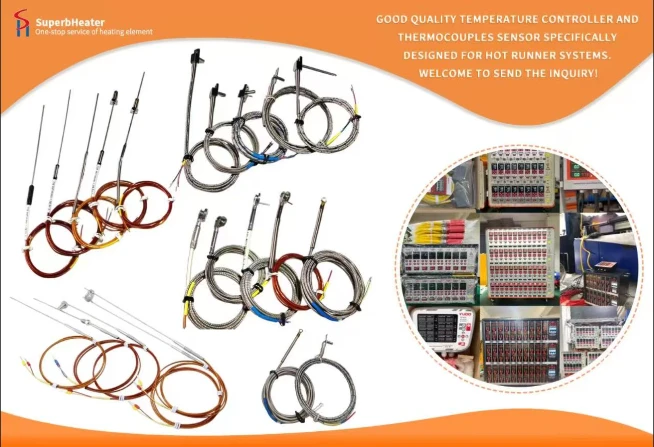
Sensor Selection for Speed. For packaging molds, use 1.0 mm diameter grounded thermocouples with time constants under 0.2 seconds. Smaller diameter probes respond faster but are more fragile. In applications with glass-filled materials, compromise with 1.5 mm diameter to balance speed and durability.
Placement for Rapid Thermal Feedback. Install thermocouples as close to the gate as possible-typically 5–10 mm above the gate. This captures the melt temperature just before it enters the cavity. Ensure spring-loaded designs maintain constant contact despite thermal expansion.
Controller Tuning for Packaging. High-speed packaging requires aggressive PID tuning with short integral times (0.5–1.0 seconds) to enable rapid recovery. Use adaptive PID that adjusts based on cycle phase. Enable feedforward control that boosts power during injection based on the expected temperature dip.
Multi-Cavity Balancing. In packaging molds with 48–96 cavities, temperature uniformity is essential. Use thermocouple arrays on the manifold to balance zones. Implement individual nozzle thermocouples to fine-tune each cavity. Document offsets and review them weekly.
Case Study: Closure Mold. A closure mold running 3.5-second cycles experienced inconsistent filling. Upgrading to 1.0 mm grounded thermocouples and implementing adaptive PID reduced temperature variation from ±2°C to ±0.5°C, eliminating short shots and improving weight consistency.
Preventive Maintenance. In high-speed packaging, thermocouple life is shorter due to rapid thermal cycling. Inspect and replace sensors every 6 months, or more frequently if abrasives are used. Maintain a stock of pre-wired spares to minimize changeover time.