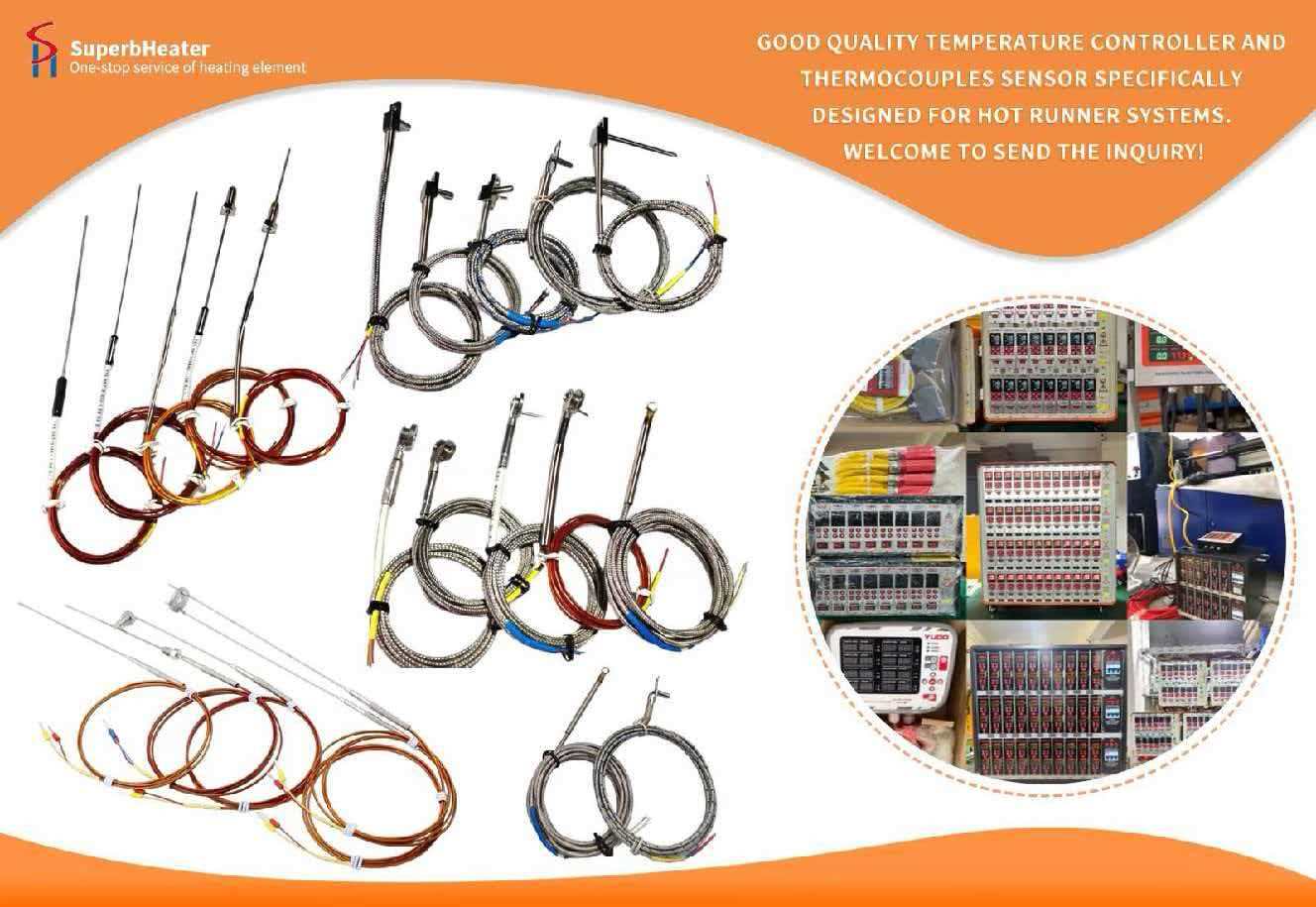
The core methods for reducing signal attenuation in hot runner sensors are optimizing wiring design, employing signal compensation technology, and strengthening electromagnetic protection. Specific measures include:
1. Shortening Wire Length or Using Signal Transmitters
Prioritize shortening the distance: Install the signal acquisition module as close to the sensor as possible, keeping the wire length within 10 meters. This significantly reduces resistance and interference.
For long-distance transmission (>30 meters): A 4–20mA signal transmitter must be used to convert the weak signal from the thermocouple or PT100 into an industrial standard current signal locally. This provides strong anti-interference capabilities and minimal transmission attenuation.
Example: In a hot runner system for injection molding machines, a miniature transmitter module can be installed near each temperature control zone to uniformly output a 4–20mA signal to the PLC.
2. Selecting High-Specification Cables and Correct Wiring Methods
Use shielded twisted-pair cables: Effectively suppress electromagnetic interference (EMI). The shielding layer must be grounded at one end to avoid noise introduced by ground loops.
PT100 uses either a three-wire or four-wire system: The three-wire system compensates for conductor resistance, while the four-wire system completely eliminates the influence of lead resistance, making it suitable for high-precision temperature measurement scenarios.
Wire Diameter Selection: It is recommended to use wires with a cross-sectional area ≥ 0.5mm² to reduce resistance per unit length and minimize voltage drop.
3. Optimize Installation Environment and Anti-interference Measures
Keep away from interference sources: Avoid laying signal lines parallel to power lines; when crossing, they should form a 90° angle; keep away from inverters, heating rods, high-power motors, and other strong electromagnetic equipment.
Install conduit: Use metal conduit and ensure reliable grounding to create a Faraday cage effect, further shielding against external interference.
Local Tip in Wuhan: High humidity during the rainy season (June–September) can easily lead to decreased insulation of long conductors; it is recommended to use IP67-rated sheathed wire or regularly check the insulation resistance of the line.
4. Signal Conditioning and Front-End Processing
Front-End Amplification and Filtering: Install a low-noise preamplifier and low-pass filter at the sensor output to improve the signal-to-noise ratio and suppress high-frequency noise.
Regular Calibration and Maintenance: Perform a systematic calibration of the sensor and wiring every 3–6 months, checking for oxidation or looseness in the wiring terminals, and cleaning or replacing them promptly.
It is recommended to use a temperature control module with self-testing capabilities (such as the MAX31855), which can monitor the cold junction temperature and communication status in real time and provide early warnings of signal anomalies.