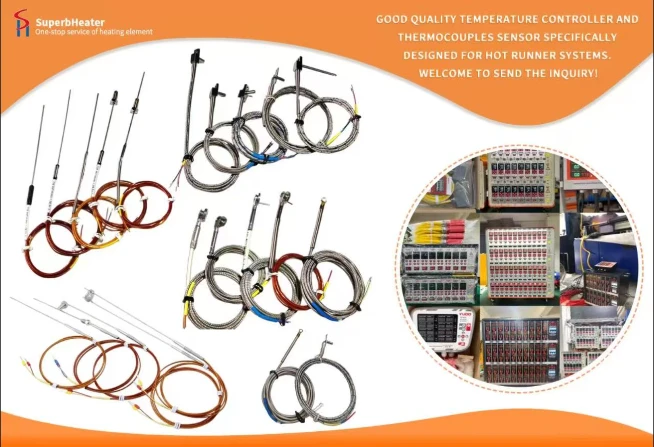
Hot runner nozzle heating systems are divided into two mainstream matching forms: integrated heater-thermocouple all-in-one assemblies and split independent heater plus separate thermocouple probes. Integrated all-in-one products have become the mainstream supporting standard for YUDO, EWIKON and most domestic medium and high-end hot runner brands.
Simplified Assembly and Disassembly. Split schemes require separate processing of thermocouple reserved holes on each nozzle heating sleeve, independent insertion of probes during mold assembly, and manual adjustment of insertion depth. For multi-cavity molds with 32 or 64 cavities, dozens of independent probes need to be installed one by one. Integrated assemblies embed the thermocouple alloy wire inside the coil heating sleeve during production, with the sensing point fixed at the geometric center of the heating coil in advance. When assembling the nozzle, only the whole heating sleeve needs to be sleeved on the nozzle body, cutting mold heating component assembly time by more than half.
Fixed Central Sensing Position. The biggest hidden trouble of split separate probes is inconsistent insertion depth during manual installation: some probes are inserted shallowly to form air gaps, while some are too deep to contact the cooling zone at the nozzle front end. The built-in thermocouple wire of integrated assemblies is fixed at the hottest central position of the heating coil by professional production technology, with zero deviation of the sensing point of each batch. The sensing wire is closely attached to the inner wall of the heating sleeve, without air gap heat resistance.
Reduced Electromagnetic Interference and Mechanical Damage. Split thermocouple cables are exposed outside the heating sleeve, arranged in the narrow gap between the nozzle and mold plate, rubbing against sharp mold edges and valve needle moving parts. The thermocouple wire of integrated assemblies is wrapped inside the brass heating sleeve, isolated from external metal components and high-current heater power lines, naturally reducing electromagnetic signal noise. The wire outlet is processed with arc smooth transition, avoiding cable torsion and extrusion damage during disassembly. The failure rate of wire fracture caused by mechanical friction is reduced by more than 80% compared with split separate probes.
Integrated Sealing Structure. The sensing wire and heating coil of the all-in-one assembly are sealed inside the metal sleeve as a whole. Plastic decomposition carbon deposits and corrosive volatile gas at the gate cannot directly wrap the hot junction welding point. This slows hot junction oxidation and carbon erosion, extending service life.
Limitations. Once either the heater or thermocouple fails, the whole integrated component needs complete replacement. Compared with separated structures that allow independent replacement, maintenance costs rise obviously. The built-in thermocouple position is fixed during production-engineers cannot adjust the sensing point location according to thermal simulation results after purchasing the assembly. The built-in thermocouple mainly reflects the temperature of the heater surface instead of the temperature near plastic melt channels.