Hot runner thermocouples, despite their rugged construction, exhibit characteristic failure modes that experienced technicians can recognize and diagnose. The most common failure is an open circuit, where the internal thermocouple wires break due to mechanical fatigue, thermal cycling, or vibration. An open circuit is detected by the controller as infinite resistance and triggers an overtemperature alarm (since the controller sees no voltage and defaults to maximum heating). Another frequent failure is a short circuit, where the mineral insulation breaks down and the two wires touch, causing a false reading that is usually lower than actual, leading to overheating and polymer degradation. A third mode is intermittent connection, where a cracked wire touches only under certain temperatures or vibrations, causing erratic temperature swings that are hard to pinpoint. Fourth, drift occurs when the thermocouple alloy gradually changes composition due to oxidation or diffusion at high temperatures, resulting in a slowly increasing offset – typically positive for K‑type and negative for J‑type after prolonged use above 300°C. Fifth, insulation degradation reduces the resistance between the leads and the sheath, creating a partial shunt that alters the thermoelectric output; this is common when moisture or plastic residues contaminate the connector or cable. Sixth, mechanical damage to the sheath – denting, abrasion, or corrosion – can expose the insulation to contaminants or change the thermal response. Seventh, polarity reversal, though not a failure of the sensor itself, is a common installation error that produces a negative voltage, causing the controller to read temperature dropping and overshoot dramatically. Eighth, cold junction compensation errors, often from a faulty ambient sensor inside the controller, can cause a constant offset that shifts with room temperature. Ninth, connector corrosion adds contact resistance, which can lead to noise and voltage drop, especially with low‑level signals. Tenth, thermal fatigue of the junction itself – the welded bead can crack after many thermal cycles, resulting in an intermittent open. Each failure mode has distinct symptoms: drift appears as gradual part weight changes, intermittent faults cause sporadic short shots or flashes, open circuits lead to heater burnout, and shorts can cause catastrophic overheating. Preventive maintenance, including regular resistance checks (open/shorted) and calibration (drift), can catch many failures early. When a failure is suspected, the fastest diagnostic method is substitution – replace the suspect thermocouple with a known good one. It is also wise to keep a failure log to identify recurring patterns, such as a particular zone or brand having higher failure rates. Understanding these failure modes enables faster troubleshooting and reduces unplanned downtime, which is critical in high‑volume production environments.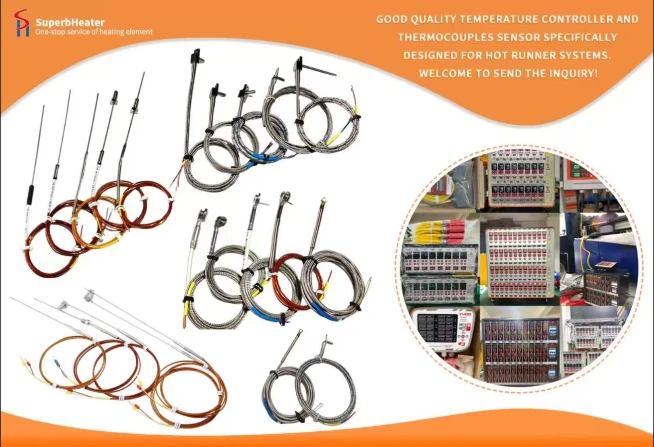

 English
- English
- Français
- Deutsch
- 日本語
- Italiano
- Español
- Português
- русский
- Indonesia
- عربي
- Ελληνικά
- Polski
- فارسی
- עברית
- Kreyòl Ayisyen
- 한국어
- Türkçe
- slovenčina
- Bai Miaowen
- Cymraeg
- dansk
- Lietuvių
- Malti
- Svenska
- Srbija jezik (latinica)
- O'zbek
- ไทย
- suomi
- magyar
- Eesti
- Català
- slovenščina
- Melayu
- Български
- اردو
- România limbi
- bosanski
- हिंदी
- Gaeilgenah Éireann
- Việt Nam
- বাংলা
- íslenska
- Norsk
- Latviešu
- hrvatski
- Nederlands
- Čeština
- українська


