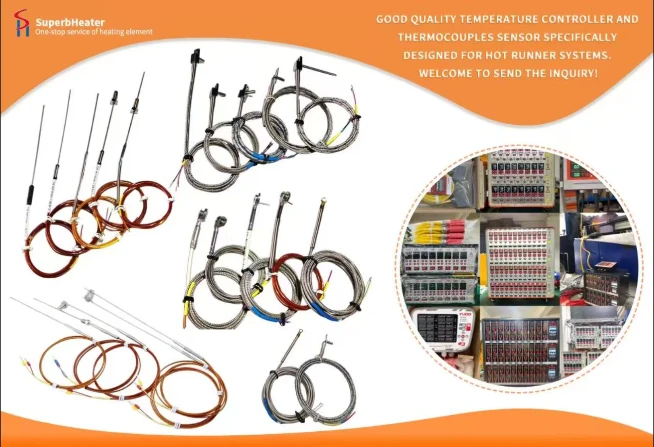
Thermocouple wires that are crushed, pinched, or improperly routed can form secondary thermoelectric junctions-additional measuring points that corrupt the temperature signal. This subtle failure mode is often overlooked but causes some of the most puzzling temperature control problems.
How Secondary Junctions Form. Thermocouple wires are made of specific alloys (chromel-alumel for Type K, iron-constantan for Type J) that generate a voltage proportional to temperature. When these wires are squeezed between the mold plate, manifold fixing block, or valve actuator, the internal alloy wire contacts the cold steel structure. This contact creates an additional thermoelectric junction at a different temperature from the intended measuring point.
The Signal Corruption Mechanism. The controller receives a voltage that is the sum of the primary junction (at the probe tip) and the secondary junction (at the pinch point). Because the pinch point is typically at a different temperature (often cooler, near the mold plate), the controller calculates the average temperature of two measuring points. The result is irregular jumping of temperature readings and mutual interference between adjacent temperature zones.
Workshop Symptoms. The symptoms are distinctive and confusing. Some cavities are underfilled while others have burnt material at the same time. Temperature readings jump erratically without any change in heater power. Zones that should be independent show correlated temperature fluctuations. These symptoms often lead maintenance teams to replace heaters or controllers unnecessarily.
Common Pinch Points. The most frequent pinch points are: between the mold plates during mold closing, under manifold fixing blocks, near valve gate actuators, and at the edges of wire routing channels. Any location where the thermocouple cable passes between moving or clamped components is a potential site for secondary junction formation.
Troubleshooting Steps. When secondary junction formation is suspected, first rearrange the wire routing path to eliminate all potential pinch points. Fix wires securely with high-temperature cable ties to avoid extrusion areas. Replace any cracked outer braided sleeves. When bending mineral-insulated sheaths, use a gentle arc to prevent metal fatigue fracture of the internal alloy wire.
Preventive Design. During mold design, include dedicated wire channels with sufficient clearance. Ensure channels are smooth and free of sharp edges. Route thermocouple cables away from moving components. Use protective sheathing at all points where cables pass near metal edges.