Temperature control accuracy in hot runner systems depends on far more than the thermocouple alone. Numerous factors interact to determine how precisely the melt temperature is maintained. First and foremost is the thermocouple's junction placement – the tip must be located at the point where temperature measurement is most representative of the actual melt. If the sensor is too far from the heater or too close to the cool mold plate, the measured value will not reflect the true nozzle temperature. The thermal conductivity of the surrounding metal, the presence of air gaps, and the tightness of the probe fit all influence heat transfer and response time. Second, the controller's PID parameters must be tuned to the specific zone's thermal mass and heating power. Poor tuning leads to oscillations or slow response, causing under‑ or overshoot. Modern auto‑tune functions help, but they require stable sensor signals. Third, the heater's power density and placement affect temperature uniformity; uneven heating creates hot spots that the thermocouple may not detect. Fourth, the cooling system of the mold plate can extract heat from the nozzle or manifold, introducing disturbances that the control loop must compensate for. Fifth, the thermocouple signal itself is subject to electromagnetic interference from the heater cables, motor drives, and other machinery. Shielding, grounding, and proper cable routing are essential to preserve signal integrity. Sixth, the controller's sampling rate and resolution – a slow or low‑resolution controller will not capture rapid temperature changes, leading to lag. Seventh, the thermocouple's own aging and drift over time alter its output, so regular calibration is mandatory. Eighth, environmental factors such as ambient temperature changes and drafts can affect the reference junction compensation, especially if the cold junction is not properly temperature‑compensated. Ninth, the thermal response time of the thermocouple must match the speed of the process – a sluggish sensor cannot react to fast cycle changes. Finally, the interaction between adjacent zones in a manifold can cause cross‑talk; if one zone heats up, it may affect neighboring zones. Advanced systems use zone‑to‑zone decoupling algorithms, but these rely on accurate thermocouple data. Understanding and managing all these factors is necessary to achieve and maintain the ±1°C accuracy demanded by high‑precision molding. Regular system audits, including thermocouple verification, heater resistance checks, and control loop testing, help identify and correct issues before they affect part quality.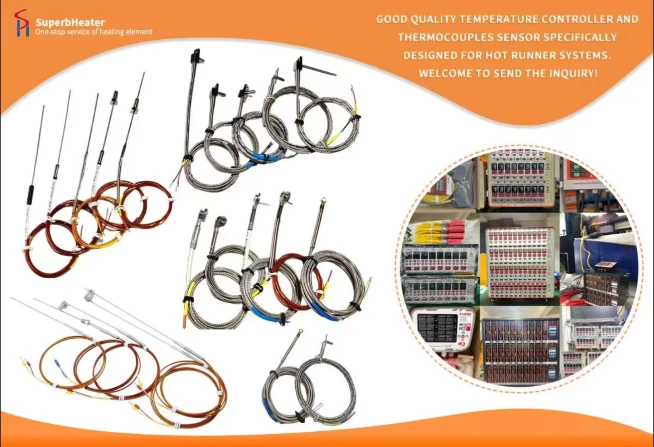

 English
- English
- Français
- Deutsch
- 日本語
- Italiano
- Español
- Português
- русский
- Indonesia
- عربي
- Ελληνικά
- Polski
- فارسی
- עברית
- Kreyòl Ayisyen
- 한국어
- Türkçe
- slovenčina
- Bai Miaowen
- Cymraeg
- dansk
- Lietuvių
- Malti
- Svenska
- Srbija jezik (latinica)
- O'zbek
- ไทย
- suomi
- magyar
- Eesti
- Català
- slovenščina
- Melayu
- Български
- اردو
- România limbi
- bosanski
- हिंदी
- Gaeilgenah Éireann
- Việt Nam
- বাংলা
- íslenska
- Norsk
- Latviešu
- hrvatski
- Nederlands
- Čeština
- українська


