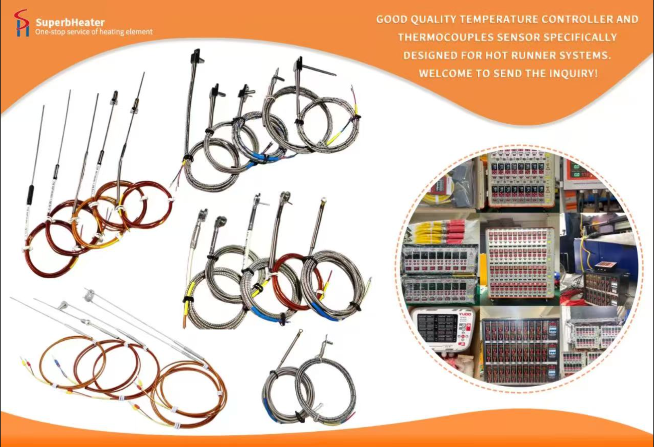
The hot runner industry offers a wide range of products tailored to different molding applications, from small medical components to large automotive panels. Every major hot runner product-including manifolds, nozzles, valve-gate systems, temperature controllers, and heating assemblies-depends on precision thermocouples for stable operation. Understanding how thermocouples integrate with these products helps users select the right sensors, reduce failures, and improve system longevity.
Manifolds are the central distribution units of hot runner systems. They feature internal melt channels and embedded cartridge or coil heaters. Thermocouples are inserted into drilled holes close to the flow path to monitor bulk melt temperature. Proper positioning ensures the sensor does not touch the heater directly but remains close enough to capture real thermal conditions. Manifolds for high-cavity molds often include multiple thermocouples to maintain zone balance. In large-scale manifolds, uneven temperature distribution can cause inconsistent filling, making sensor accuracy critical.
Nozzles are among the most thermally demanding components. They transfer melt from the manifold to the mold cavity and operate at the highest temperatures. Open nozzles, valve-gate nozzles, and thermal gate nozzles all require thermocouples near the tip. Valve-gate nozzles, in particular, need fast-response sensors to prevent drooling or cold slugs during pin actuation. Most nozzle thermocouples are mineral-insulated, with diameters of 1.0 mm or 1.5 mm to fit restricted spaces.
Valve-gate actuators, whether pneumatic or hydraulic, work alongside temperature control systems. Although actuators are mechanical, their performance is affected by nozzle temperature. If thermocouples fail, overheating can degrade polymer near the gate, causing burns or gas marks. Therefore, valve-gate systems rely on stable thermocouple signals to synchronize mechanical and thermal processes.
Hot runner temperature controllers receive input from thermocouples and regulate power to heaters. Advanced controllers support auto-tuning, fuzzy logic, and multi-zone synchronization. They can detect thermocouple faults such as broken wires, ground loops, and signal drift. Controllers act as the brain of the system, but their effectiveness is limited by the quality of the thermocouple signal.
Coil heaters, band heaters, and nozzles heaters generate the necessary heat. Thermocouples ensure heaters do not overshoot or undershoot. Without accurate feedback, heaters may cycle excessively, shortening their lifespan and causing thermal stress on the hot runner components.
Connectors, cables, and terminal boards protect thermocouple signals from electromagnetic interference, heat, and physical damage. High-temperature cables with braided shielding are essential in industrial molding environments. Molded connectors prevent plastic splashes and moisture from entering the circuit.
Specialized hot runner products, such as micro-injection systems, multi-shot molds, and gas-assisted hot runners, also depend on customized thermocouples. Micro-nozzles require ultra-miniature sensors, while multi-shot systems need thermocouples resistant to different polymer temperatures.
In summary, nearly every hot runner product relies on thermocouples to function correctly. Selecting thermocouples that match product design, material, and application ensures stable production, fewer defects, and lower maintenance costs.