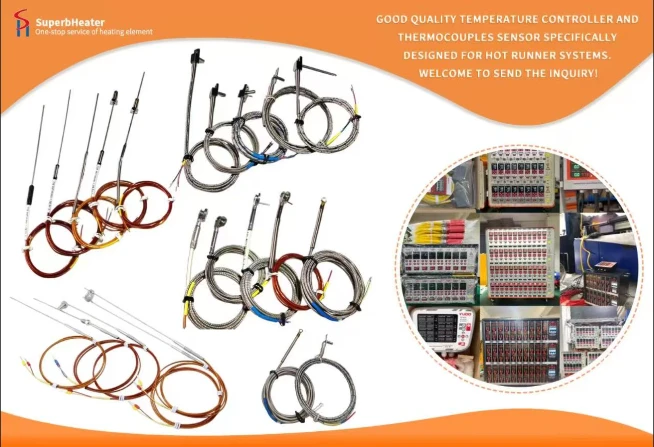
Modern hot runner systems often feature 8, 16, 32, or even 64 independent temperature control zones. In such complex configurations, thermocouples are the critical sensors that enable zone-level precision and thermal balancing. This article explores the unique challenges and strategies for multi-zone thermocouple deployment.
The Architecture of Multi-Zone Systems. A typical multi-zone hot runner includes a central manifold with multiple flow channels, each feeding one or more nozzles. Each nozzle has its own heater and thermocouple. Manifold zones may also have separate sensors. The controller uses individual PID loops per zone, aiming to maintain each zone at its setpoint independently.
The Challenge of Thermal Crosstalk. In a compact manifold, adjacent zones conduct heat to each other. If Zone A runs hotter due to a material requirement, it heats Zone B through conduction. Zone B's thermocouple detects this and tries to reduce power, but that reduces its own nozzle temperature, which may be needed. The interaction can cause oscillation across zones-known as "zone fighting." Accurate, fast thermocouples help the controller distinguish between intended heating and interference.
Sensor Placement Strategies. Placement is paramount. Manifold thermocouples should be located midway between heaters, near the actual melt stream, not too close to a heater cartridge which gives false high readings. Nozzle thermocouples should be near the tip, where the last temperature control occurs before melt enters the cavity. In long nozzles, consider two thermocouples-one at the inlet, one at the tip-to capture gradient.
Balancing Multiple Zones. In high-cavity molds, each zone should ideally show the same temperature at setpoint. But variations in heater performance, thermocouple calibration, and heat losses cause offsets. By mapping each zone's thermocouple reading against a reference (e.g., using a scanning pyrometer), engineers can apply individual offsets to the controller. This balancing ensures each cavity receives melt of the same viscosity.
Diagnostics through Zone Comparison. Multi-zone systems enable powerful diagnostics: if one zone consistently demands more power than others, its thermocouple may be reading low (drift) or the heater may be degrading. Conversely, if a zone demands much less power, the thermocouple may be reading high. Trend analysis across zones, using data from each thermocouple, can preempt failures.
Data Acquisition and Centralized Monitoring. Advanced controllers with data logging can record each zone's temperature, power output, and alarms over time. This data is invaluable for troubleshooting. For example, if parts from cavity #12 are consistently undersized, reviewing the thermocouple trend for that zone may reveal a 2°C downward drift that went unnoticed.
Benefits of Zone Grouping. Some controllers allow grouping zones that share a common setpoint, with a single master thermocouple controlling multiple heaters. This reduces cost but sacrifices individual control. It is only acceptable if thermal coupling between those zones is very strong and consistent. Otherwise, independent thermocouples per zone are essential.
Calibration in Multi-Zone. Calibrating every thermocouple in a 64-zone system is time-consuming but necessary. Use a portable calibrator that can be sequentially connected to each thermocouple input. Alternatively, some systems allow in-situ calibration by comparing zone readings during a steady-state period when all zones are at setpoint and no injection occurs-assuming uniform temperature, deviations indicate sensor errors.
Redundancy for Critical Zones. In expensive molds, consider redundant thermocouples for the most critical zones (e.g., the main manifold branch). If one sensor fails, the backup allows production to continue. The controller can average the two readings or switch automatically upon alarm.
Impact on Molding Quality. Multi-zone control, enabled by accurate thermocouples, directly improves part quality. For complex parts with varying wall thickness, different zones can be set to different temperatures: hotter for thick sections to reduce voiding, cooler for thin sections to avoid flash. Without per-zone thermocouples, this strategy is impossible.
Future: Smart Zone Control. With Industry 4.0, thermocouples are becoming nodes in a network, transmitting not just temperature but also trend data, self-diagnostics, and calibration history. Controllers use machine learning to predict optimal zone settings based on past cycles, reducing reliance on manual tuning.