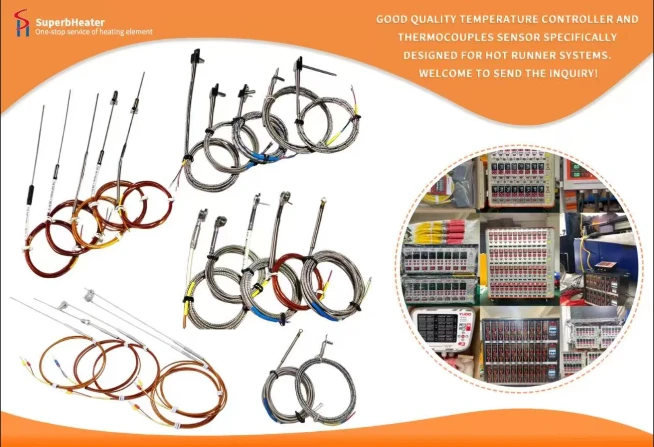
Thermocouple shielding protects the small signal from electrical interference. Without it, noise couples into the sensor wire, creating temperature instability and measurement errors. Proper shielding is essential for reliable operation.
What Shielding Does
Shielding is a conductive layer around the thermocouple wires that blocks electromagnetic interference. The shield is typically a copper braid or foil. By grounding the shield at one end, noise currents are diverted to ground before they reach the signal. It's simple but effective.
Why It's Needed
In an injection molding facility, electrical noise is everywhere. Heater cables carry high current. Servo drives generate high-frequency noise. Induction heating creates electromagnetic fields. The thermocouple signal is only a few microvolts per degree. Without shielding, the noise can overwhelm the signal.
The Grounding Rule
Shield grounding is specific: ground only at one end. Multiple grounds create a ground loop-a path for current to flow through the shield. The current creates a voltage across the shield resistance that appears as electrical noise. The shield should be grounded at the controller end, not at the sensor end.
What Not to Do
Do not connect the shield to the mold. The mold is often grounded through the machine, creating a second ground point. Do not leave the shield ungrounded-it acts as an antenna, picking up more interference. Do not ground the shield at both ends.
Checking the Shield
The shield should show continuity to ground at the controller end. Use a multimeter to verify. If the shield is connected to the mold, disconnect it. If the shield is not connected at either end, connect it to the controller ground.
When Shielding Is Critical
In high-electrical-noise environments, shielded cables are mandatory. With unshielded cables, temperature fluctuations of 5-10°C are common. With proper shielding, the reading is stable to within the sensor's accuracy. The investment in shielded cables pays for itself in process stability.