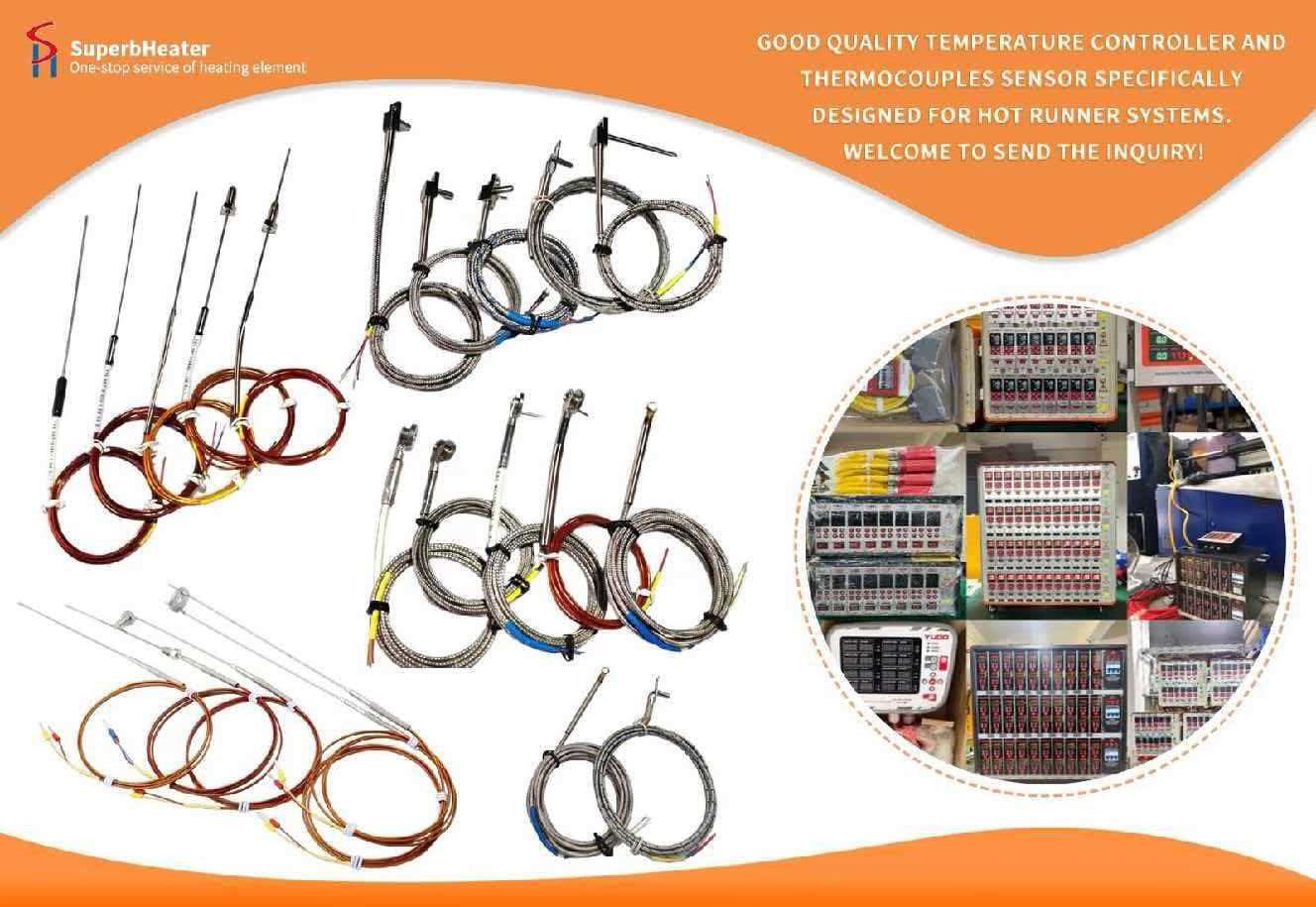
In a precision automobile injection moulding workshop, a Husky Altanium hot runner temperature control system uses Type K thermocouples with a range of 0~800℃ to measure temperature in the runner of precision-molded vehicle bumpers. The thermocouples have just been repaired and calibrated end-to-end, and accuracy verification is necessary to ensure compliance with IATF 16949 quality system metrological traceability criteria.
Before verification, prepare Class II standard Type K thermocouples calibrated by CNAS, low-potential DC potentiometers with a 0.02 class accuracy, and high-precision digital thermometers. All standard equipment is within its metrological validity period, and its accuracy is greater than one-third of the allowed error of the thermocouple under calibration.
On-site step-by-step verification procedure:
Installation and repair: Twice wrap platinum wire around the hot junctions of the standard thermocouple and the freshly calibrated Husky thermocouple before inserting them into the temperature measurement hole of the hot runner's main gate. Ensure that both temperature measurement ends are in full contact with the runner's metal wall and in the same temperature field.
To compare temperature fields, sequentially establish three common production temperatures for the hot runner: 200℃, 400℃, and 600℃. Stabilise each temperature for 30 minutes, keeping the temperature field change below 0.2℃/min.
Cyclic Reading Recording: For each temperature point, read it four times in a forward-reverse order of "standard-calibrated-standard," and record the average value.
200℃: Standard thermocouple read 200.3℃, Husky thermostat reported 200.9℃, +0.6℃.
The standard thermocouple showed 399.7℃, whereas the Husky thermostat displayed 400.2℃, with a +0.5℃ variation.
The standard thermocouple showed 600.5℃, but the Husky thermostat displayed 601.1℃, with a +0.6℃ variation.
Stability test: After heating to 400℃ and maintaining a steady temperature for 2 hours, the thermostat's temperature curve variation was ≤±0.8℃, with no leaps or unidirectional drift.
Cold Junction Compensation Verification: The module was tested at three room temperatures (20℃, 25℃, and 30℃). The greatest deviation of cold junction compensation was 0.08℃, significantly lower than the permitted threshold of ±0.1℃.
Hysteresis and Insulation Verification: The difference between two measurements at the same temperature point (heating and cooling) was 0.4℃, ≤±0.5℃, which is acceptable. The thermocouple's insulation resistance to the shell was 120MΩ, ≥100MΩ, which is acceptable.
Verification Results: All test points had a maximum deviation of +0.6℃, which is significantly lower than the national standard of ±2.5℃ for type K thermocouples. All performance indicators fulfilled the norms, and the accuracy after calibration was considered acceptable. The thermocouple can now be legally used in the precision moulding of vehicle bumpers. The verification record can be instantly uploaded to the IATF 16949 quality system metrological traceability repository.
This example is perfectly suited to the actual application scenario of Husky hot runner systems and can be used as a reference template for on-site accuracy verification.