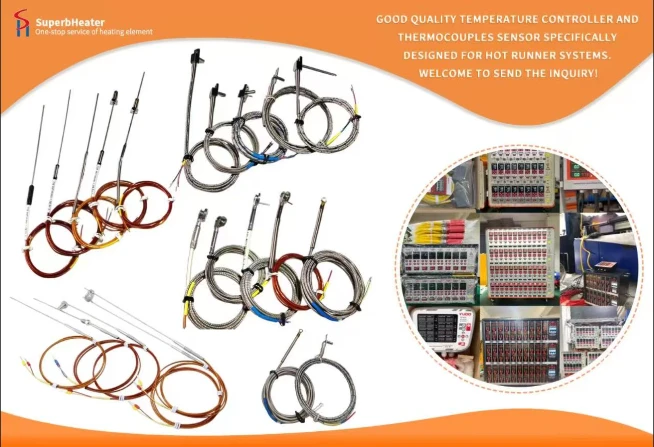
When thermocouple problems arise, rapid diagnosis and effective resolution are essential to minimize production downtime. This article provides practical troubleshooting procedures for common hot runner thermocouple failures.
Diagnostic First Steps. The first step in troubleshooting is to confirm the fault phenomenon. Most modern controllers display specific alarm codes: E02 for open circuit, E03 for reversed polarity, E09 for short circuit. Checking the alarm code immediately directs the technician toward the most likely cause.
Wiring Verification. Verify wiring by checking for loose terminals, reversed polarity, or damaged compensation wires. Incompatible wiring can be the source of heater and thermocouple failure, causing runaway heating, degradation of protective seals, and severe mold damage. Use a multimeter to measure resistance and voltage to judge open circuit and short circuit conditions.
Connector Inspection. Check the heavy-duty connector (HDC) pins first when an open circuit alarm appears. Connectors must be firmly plugged and protected from heat and contamination. Many connector issues can be resolved simply by reseating or replacing connector pins.
Thermocouple Testing. Insert a calibrated reference thermocouple probe near the suspect thermocouple location on the mold surface and compare the two readings. A significant offset between the reference and the installed thermocouple confirms sensor drift or incorrect polarity. For ungrounded thermocouples, perform a continuity test by setting a multimeter to read Ohms resistance; if you see an Ohms resistance to ground, replace the thermocouple.
Polarity Correction. Temperature reversal due to reversed positive/negative poles can be fixed by simply swapping the wiring to match the positive (+) and negative (-) poles of the thermocouple and controller module. Check thermocouple extension wire connections in the junction box for correct polarity.
Short Circuit Resolution. For short circuits, inspect for plastic leakage or moisture intrusion. Check whether thermocouple wires are in contact with hot runner metal shells causing metal short circuit, which will trigger controller automatic protection and shield temperature display.
Thermal Shock Prevention. To mitigate thermal shock damage, operators should implement controlled heat-up ramps, avoid sudden cooling, and ensure thermocouples reach near-system temperature before being fully seated. Maintenance teams should inspect thermocouples that have undergone emergency shutdowns for early signs of drift.
Preventive Maintenance. Regular preventive maintenance is far more cost-effective than reactive repairs, as it reduces the risk of unplanned downtime and extends the service life of thermocouples by up to 50%. Calibrate every 6–12 months and perform thermal cycling aging tests regularly.