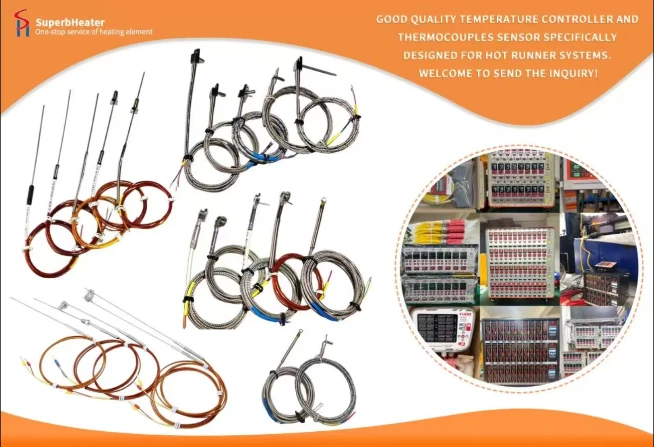
Selecting the right thermocouple for hot runner applications requires evaluating several key technical specifications. Not all sensors are equal, and choosing based solely on price or availability often leads to premature failure and production issues.
Thermocouple Type. Thermocouple type is fundamental. Type K is the most widely used in hot runner systems due to its broad temperature range and stability. Type J is suitable for lower temperature environments, while Type T offers good low-temperature performance. Type N offers improved oxidation resistance and reduced drift for long-term high-temperature use.
Temperature Range. The temperature rating must exceed process conditions. The continuous-use rating should be at least 100°C to 200°C higher than actual operating temperature to avoid accelerated aging. Most reliable hot runner thermocouples are rated for 600°C or higher. K-type thermocouples (-200 to 1300°C) are recommended for most applications due to their strong oxidation resistance and good stability.
Sheath Diameter. Sheath diameter balances response and strength. Common sizes are 1.0 mm, 1.5 mm, and 2.0 mm. Smaller diameters provide faster response, ideal for nozzle tips, but are more fragile. Larger diameters offer greater durability for manifold zones but respond more slowly. Prioritize armored thermocouples with probe diameters of 1.5mm or less for critical applications.
Junction Type. Grounded junctions provide the fastest response, making them ideal for nozzles. Ungrounded junctions reduce electrical interference, preferred for manifolds in high-noise environments. The junction type should be chosen based on noise levels in the operating environment.
Sheath Material. Sheath material must resist corrosion and abrasion. 316L stainless steel works for general applications. Inconel 600 is preferred for long-term high-temperature use and resistance to polymer vapors. For highly corrosive resins, specialized alloys are available.
Insulation Material. High-purity magnesium oxide (MgO) provides excellent thermal conductivity and electrical isolation. Dense, compacted insulation resists moisture and maintains performance over thermal cycling. Insulation resistance indicates long-term reliability; higher insulation resistance means less signal leakage and greater resistance to moisture and contamination.
Connector Type. Industry-standard plugs ensure interchangeability and secure connection. Sealed, high-temperature connectors prevent contamination and signal loss.
Installation Structure. Installation structures include threaded, bayonet, patch, and needle types. Threaded types are stable for manifolds; needle types fit compact nozzles. The correct diameter depends on space, mechanical stress, and required speed.
Accuracy Class. High-end European hot runners for medical and automotive precision parts must select Class I precision sensors to meet strict dimensional tolerance standards; mass-produced packaging molds can choose cost-effective Class II thermocouples.