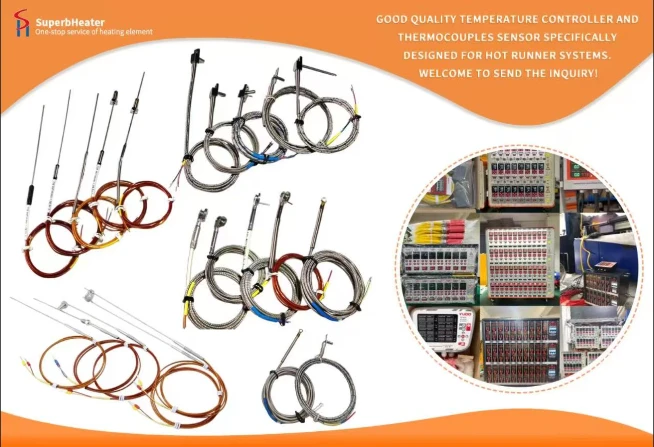
Response time varies significantly between thermocouple types, sheath diameters, and junction configurations. Understanding these differences helps you select the right sensor for your application.
Type J vs. Type K Response
The response time differences between Type J and Type K sensors of the same construction are minimal. The thermal conductivity of the alloys is similar, so the heat transfer characteristics are comparable. The bigger differences come from construction, not material.
Sheath Diameter Response
A 0.5mm diameter thermocouple has a response time of approximately 0.5-1 second. A 1.0mm diameter sensor is about 1.5-3 seconds. A 1.5mm diameter sensor is 3-5 seconds. The response time increases approximately with the square of the diameter. Doubling the diameter roughly quadruples the response time. For fast-response applications, the smaller diameter is the way to go.
Grounded vs. Ungrounded Response
A grounded junction thermocouple has a response time that's about 30% faster than an ungrounded sensor of the same diameter. The direct metal-to-metal contact between junction and sheath conducts heat more quickly. The trade-off is noise immunity-ungrounded sensors are quieter.
The Effect of Mounting on Response
Response time is affected by how the sensor is mounted. A sensor with good thermal contact (tight fit, good seating) responds faster than one with poor contact (loose fit, air gap). A poorly mounted 0.5mm sensor can respond slower than a well-mounted 1.5mm sensor. Installation quality matters more than sensor construction.
The Application-Based Choice
For fast-cycle packaging (thin-wall, under 5-second cycles), use small diameter (0.5mm), grounded junction sensors. For standard automotive parts (10-20 second cycles), 1.0mm sensors are fine. For large parts (over 30 seconds), 1.5mm sensors are adequate. Match the sensor to the application.
The Over-Spec Risk
Using a faster sensor than you need doesn't hurt anything, but it costs more and may be more fragile. The small diameter sensors are more susceptible to mechanical damage. If you don't need the fastest response, consider using a slightly larger sensor for robustness.