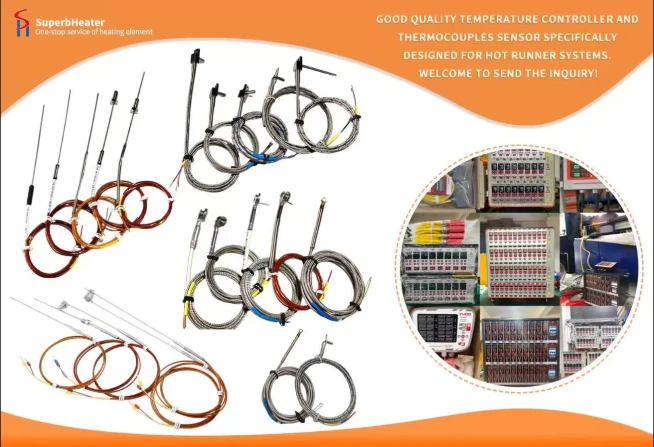
Thermocouple technology is standardized, but its implementation varies between injection molding press brands and hot runner system suppliers. Understanding these variations helps when moving molds between different machines or when standardizing across a facility.
Controller Compatibility
Different press brands use different temperature controllers. Some require specific thermocouple types. Some use proprietary connector arrangements. A mold set up for one brand's controller may not work on another without adaptors or configuration changes. This is the most common compatibility issue.
The Connector Variation
Connector types vary widely. Miniature, standard, thermocouple-specific, and proprietary connectors are all used. When moving a mold from one press to another, the connector may need to be changed. Using adaptor cables is the simplest solution. Some facilities standardize on one connector type across all presses, which simplifies mold changes.
Sensor Type Preferences
Some controllers work best with Type K; others with Type J. While modern controllers can often handle both with configuration changes, older controllers may have a fixed preference. This affects the sensor you stock for each press.
Calibration Differences
Calibration standards are consistent, but the interface for calibration is manufacturer-specific. Entering the calibration offset on a Husky controller is different from doing it on an EWIKON controller. The maintenance team must be familiar with each controller's calibration procedure.
Software and Features
Advanced controller features (autotune, error compensation, etc.) are implemented differently by each manufacturer. The thermocouple provides the raw data; how that data is used varies. Standardizing on one controller brand simplifies training, but many facilities have a mix.
Training Considerations
If you have multiple brands, your maintenance team must be trained on each. This increases training time and cost. Standardizing on one brand reduces this burden. However, sometimes the best technical solution for a specific application is from a different manufacturer.
The Standardization Decision
For a facility with many presses, standardizing on one controller and thermocouple system simplifies maintenance and training. The initial investment in standardization pays for itself in reduced complexity. For small facilities with few presses, the cost of standardization may not be justified. The decision is economic, not technical.