Large multi-cavity molds, common in automotive and packaging industries, present a formidable challenge: maintaining thermal balance across dozens of cavities. The hot runner manifold distributes the melt, but variations in flow path length, heat loss to the mold plate, and heater power create temperature gradients that result in part weight and dimension variations. Thermocouples are the primary tool to detect and correct these imbalances. The first step is to understand the temperature profile. Using the installed thermocouples, record the temperature of each zone after stabilization. If the temperatures vary by more than 1-2°C, thermal imbalance exists. The next step is to identify the pattern: are the colder zones at the edges (common due to heat loss to the mold frame) or scattered randomly (suggesting uneven cooling lines or heater problems)? For edge-cold zones, the solution is to apply a higher setpoint (e.g., 3°C higher) to compensate. This is a manual offset. For more systematic compensation, some controllers offer "zone mapping" where the thermal interaction between zones is modeled. This allows the controller to automatically adjust the power to neighboring zones to maintain uniform temperature. The thermocouple data is used to feed this model. Another approach is to redistribute the heater power. If certain zones are always cold, consider using higher-wattage heaters or adding auxiliary heaters. Thermocouple data guides this decision-if a zone requires a significantly higher setpoint to maintain balance, it likely needs a heater upgrade. Cooling lines also affect thermal balance. If the cooling water is running too close to a zone, that zone will be cooler. Thermocouple data can reveal this; the corrective action is to adjust cooling line routing or add a thermal break (insulating material) between the hot runner and the cooled plate. In some molds, the thermal imbalance is dynamic-it changes with cycle time. Faster cycles cause more heat generation in the manifold, which may affect the outer zones differently. Thermocouple data over varying cycle times helps identify these changes and adjust setpoints accordingly. For molds with over 64 cavities, achieving perfect thermal balance is nearly impossible, but by using thermocouple data to apply zone-specific offsets, the temperature can be brought within ±1°C. This is sufficient to ensure part weight variations within acceptable limits. The final step is to validate the balance by measuring part weight from each cavity and correlating it with the thermocouple data. If cavity weight is consistent across all zones, thermal balance has been achieved. By treating thermocouples as the eyes of the balancing process, engineers can systematically eliminate thermal gradients and achieve uniform part quality.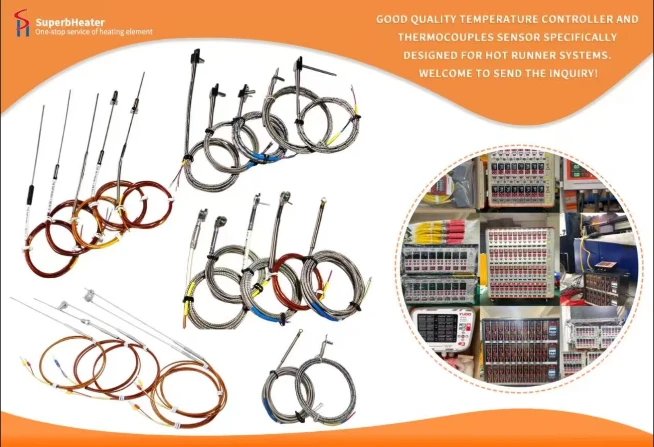

 English
- English
- Français
- Deutsch
- 日本語
- Italiano
- Español
- Português
- русский
- Indonesia
- عربي
- Ελληνικά
- Polski
- فارسی
- עברית
- Kreyòl Ayisyen
- 한국어
- Türkçe
- slovenčina
- Bai Miaowen
- Cymraeg
- dansk
- Lietuvių
- Malti
- Svenska
- Srbija jezik (latinica)
- O'zbek
- ไทย
- suomi
- magyar
- Eesti
- Català
- slovenščina
- Melayu
- Български
- اردو
- România limbi
- bosanski
- हिंदी
- Gaeilgenah Éireann
- Việt Nam
- বাংলা
- íslenska
- Norsk
- Latviešu
- hrvatski
- Nederlands
- Čeština
- українська


