The increasing use of heat-sensitive and bio-based resins in injection molding presents special challenges for thermocouple selection. Heat-sensitive resins-such as PVC, PLA, and some grades of PC-have very narrow processing windows, often just 5-10°C. Exceeding the upper limit for even a short time causes degradation, releasing corrosive gases or forming gel particles. Bio-resins like PLA and PHA are also sensitive to temperature and moisture. For these materials, the thermocouple must have exceptional accuracy and stability, as even a 1°C error can push the melt into the degradation zone. Class 1 or special-tolerance thermocouples (±0.5°C) are mandatory. The response time must be very fast to detect any rapid heating that could cause localized hotspots; grounded junctions with thin probes (0.8-1.0mm) are recommended. The sheath material must be inert to the resins' degradation products. For PVC, which releases HCl at high temperatures, Inconel or Hastelloy is necessary; stainless steel will corrode rapidly. For PLA, which is acidic, 316 stainless steel may suffice, but Inconel offers a longer life. Another crucial factor is the elimination of any possible contamination. The thermocouple and its cable should be free of materials that could leach into the melt or the environment; medical-grade versions with USP Class VI certification are required for food-contact or medical bio-resins. The cold end and connector must be sealed to prevent moisture ingress; bio-resins are hygroscopic, and any moisture in the thermocouple's mineral insulation could migrate and affect the melt. Some processors use a "thermal safety" approach: they set the controller's high-limit alarm to just 3°C above the setpoint, and the thermocouple must be accurate enough to prevent nuisance trips. This requires frequent calibration-some plants calibrate weekly for bio-resin molds. Also, because heat-sensitive materials have a very low thermal conductivity, the melt temperature can vary significantly from the metal temperature. Therefore, thermocouples should be placed as close to the melt channel as possible, preferably with a thin wall between the sensor and the melt. In some advanced systems, an additional thermocouple is placed in the melt channel itself (using a special probe) to directly measure the melt temperature. While this is invasive, it provides the most accurate data. By carefully selecting thermocouples for heat-sensitive and bio-resins, molders can process these challenging materials successfully, producing high-quality, sustainable products.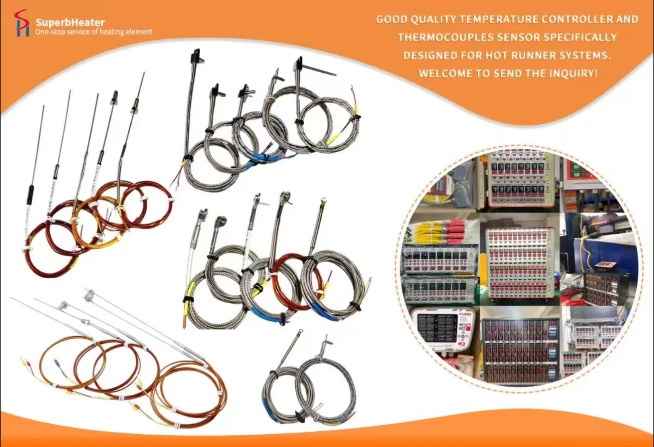

 English
- English
- Français
- Deutsch
- 日本語
- Italiano
- Español
- Português
- русский
- Indonesia
- عربي
- Ελληνικά
- Polski
- فارسی
- עברית
- Kreyòl Ayisyen
- 한국어
- Türkçe
- slovenčina
- Bai Miaowen
- Cymraeg
- dansk
- Lietuvių
- Malti
- Svenska
- Srbija jezik (latinica)
- O'zbek
- ไทย
- suomi
- magyar
- Eesti
- Català
- slovenščina
- Melayu
- Български
- اردو
- România limbi
- bosanski
- हिंदी
- Gaeilgenah Éireann
- Việt Nam
- বাংলা
- íslenska
- Norsk
- Latviešu
- hrvatski
- Nederlands
- Čeština
- українська


