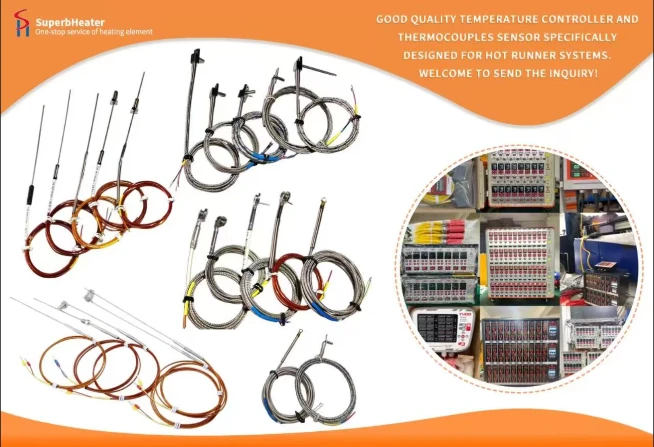
Signal drift is the slow, insidious degradation of thermocouple accuracy that sneaks up on production quality. Unlike a sudden open circuit that triggers immediate alarm, drift builds incrementally-a degree here, two degrees there-until suddenly parts are failing inspection and no one can explain why. Understanding drift mechanisms and implementing countermeasures is essential for maintaining consistent part quality.
What Causes the Drift
The primary culprit is selective oxidation of the thermocouple alloy, particularly in Type K sensors where the negative leg (alumel) undergoes grain boundary oxidation at temperatures above 200°C. This changes the thermoelectric characteristics of the wire, gradually shifting the voltage-temperature relationship. Over 10,000 hours at 300°C, a Type K thermocouple can drift by 2-5°C. At 500°C, that same drift might exceed 10°C. The problem is that the drift is rarely linear-it accelerates as the material continues to degrade, making it particularly hard to compensate.
What Drift Looks Like in Production
You might notice that the temperature controller is holding setpoint perfectly, but part weights are slowly increasing. Or dimensions are drifting toward the upper spec limit. Or surface finish quality is declining. When everything on the controller looks normal, technicians often blame the material batch or the injection unit. Meanwhile, the thermocouple is reading 3°C low, the controller is overheating the zone to compensate, and the plastic is degrading. This is the hidden cost of drift-it creates problems that are attributed to everything except the sensor.
Prevention Through Selection
Some sensors drift less than others. Type J thermocouples (iron-constantan) tend to have better stability at moderate temperatures (below 400°C) than Type K. Heavy-gauge thermocouples with thicker wires drift more slowly because there's more material to oxidize before the signal shifts. Thermocouples with sheaths that seal the internal magnesium oxide from moisture ingress maintain stable insulation resistance longer. The premium you pay for a better sensor is usually recouped within a few months of avoiding drift-related quality issues.
Calibration as a Countermeasure
Regular calibration is the most practical defense against drift. Annual calibration is a minimum; quarterly or even monthly is better for critical applications. Calibration compares the thermocouple reading to a known reference at the operating temperature and quantifies the error. If the error is consistent, the controller offset can be adjusted. If the error is increasing, it's time to replace the sensor. I recommend keeping calibration records as part of your quality documentation-they show when drift began and guide replacement scheduling.
What's Acceptable Drift?
There's no single answer-it depends on your process. For polypropylene packaging, 3°C drift might be acceptable. For medical-grade PEEK or polycarbonate, 1°C drift can be critical. A good rule of thumb is to replace the thermocouple when drift exceeds half the allowable process window. If your material has a 5°C processing window, replace the sensor when drift reaches 2.5°C. Waiting until you're at the limit guarantees you'll produce out-of-spec parts.
Automatic Compensation Strategies
Some modern controllers offer drift compensation features where the controller learns the thermocouple's characteristic and applies a correction factor. But this only works if the drift is linear and predictable-which it rarely is. I'm skeptical of relying on software to fix a hardware problem. When a sensor is drifting, replace it. Trying to compensate through software is like adjusting the speedometer while the transmission is failing.
The Role of Dual Sensors
For critical zones, consider dual thermocouples-two independent sensors in the same location. If they read consistently with each other, you have confidence in the measurement. If one starts drifting relative to the other, you have early warning. This isn't cheap, but for high-value molds running 24/7, the insurance is worth the cost.