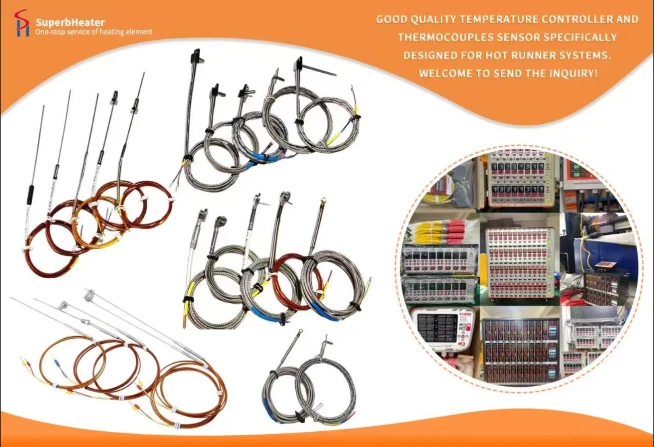
Walk into any injection molding shop and you'll see thermocouples installed in hot runner systems, but ask the maintenance manager why they're placed exactly where they are, and you'll often get a shrug. Most installations follow conventional wisdom-"put it near the heater" or "stick it where the old one was." But conventional wisdom doesn't account for the complex thermal dynamics inside a hot runner manifold. Thermal profile analysis changes that by providing empirical data that guides sensor placement based on actual thermal behavior rather than guesswork.
What Thermal Profile Analysis Actually Tells You
Thermal profile analysis is essentially a heat map of your hot runner system under operating conditions. Using a grid of temporary thermocouples or infrared thermography, you map temperature distribution across the manifold, along nozzle bodies, and near gates. This reveals hot spots where insulation is insufficient, cold spots where heat is being robbed by the mold plate, and thermal gradients that indicate poor heater distribution. Without this data, you're flying blind-assuming temperatures are uniform when they rarely are.
Why Conventional Placement Often Misses the Mark
The classic approach of placing a thermocouple right next to a heater element seems logical until you realize what you're actually measuring. You're measuring the heater temperature, not the melt temperature. Heat takes time to conduct through the steel, and thermal losses vary across the nozzle. A thermocouple reading 230°C at the heater doesn't guarantee the melt at the gate is actually 230°C-there could be a 10-15°C drop due to heat loss to the cooled mold. Profiling reveals this discrepancy and enables you to place sensors where they matter most: near the gate, where melt temperature actually affects part quality.
The Cost of Ignoring Thermal Profiling
I've seen facilities struggle with cavity-to-cavity weight variations for months, adjusting setpoints randomly without ever understanding the root cause. The problem was almost always thermal imbalance that profiling would have revealed in a single shift. They replaced thermocouples, swapped controllers, changed resins-all while the actual issue was heat loss from outer branches that no one had mapped. That's wasted labor, wasted material, and frustrated customers, all because someone skipped the profiling step.
When Profiling Makes the Biggest Difference
High-cavitation molds with 32, 64, or 96 cavities simply cannot be balanced without profiling. The outer cavities lose heat to the mold plate, the inner cavities retain heat from adjacent flow paths-thermally, they're completely different environments. You cannot use the same setpoint across all zones and expect uniform part quality. Profiling tells you exactly how much offset each cavity needs. The same applies to large manifolds where thermal gradients develop from end to end.
How to Conduct a Meaningful Profile
You don't need expensive equipment to get useful data. A good contact pyrometer and a set of temporary thermocouples are sufficient for most shops. The key is measuring at consistent locations across the system-tip of each nozzle, mid-body, manifold entry and exit points. Record measurements at startup, steady state, and under different production speeds. What you'll usually find is that the thermal map changes with production conditions, which means fixed setpoints are never optimal.
Translating Profile Data into Action
Once you have the profile, the interpretation begins. If your outer cavities read 5°C cooler than central cavities at the same setpoint, that tells you they need higher setpoints-maybe 5-8°C higher. If a particular nozzle consistently reads hotter than others, check whether its heater is oversized or its cooling channel is blocked. The thermocouple data is just the starting point; the action is adjusting the system based on what the data reveals.
Profiling as Preventive Maintenance
I recommend thermal profiling quarterly, not just during initial setup. Heaters degrade over time, changing power output. Mold steel wears, changing heat transfer characteristics. Cooling water temperatures fluctuate seasonally. All these changes affect the thermal profile. If you only profile once, you're essentially taking a snapshot and assuming nothing changes. It does change, and the profile tells you what to correct before quality drifts out of spec.