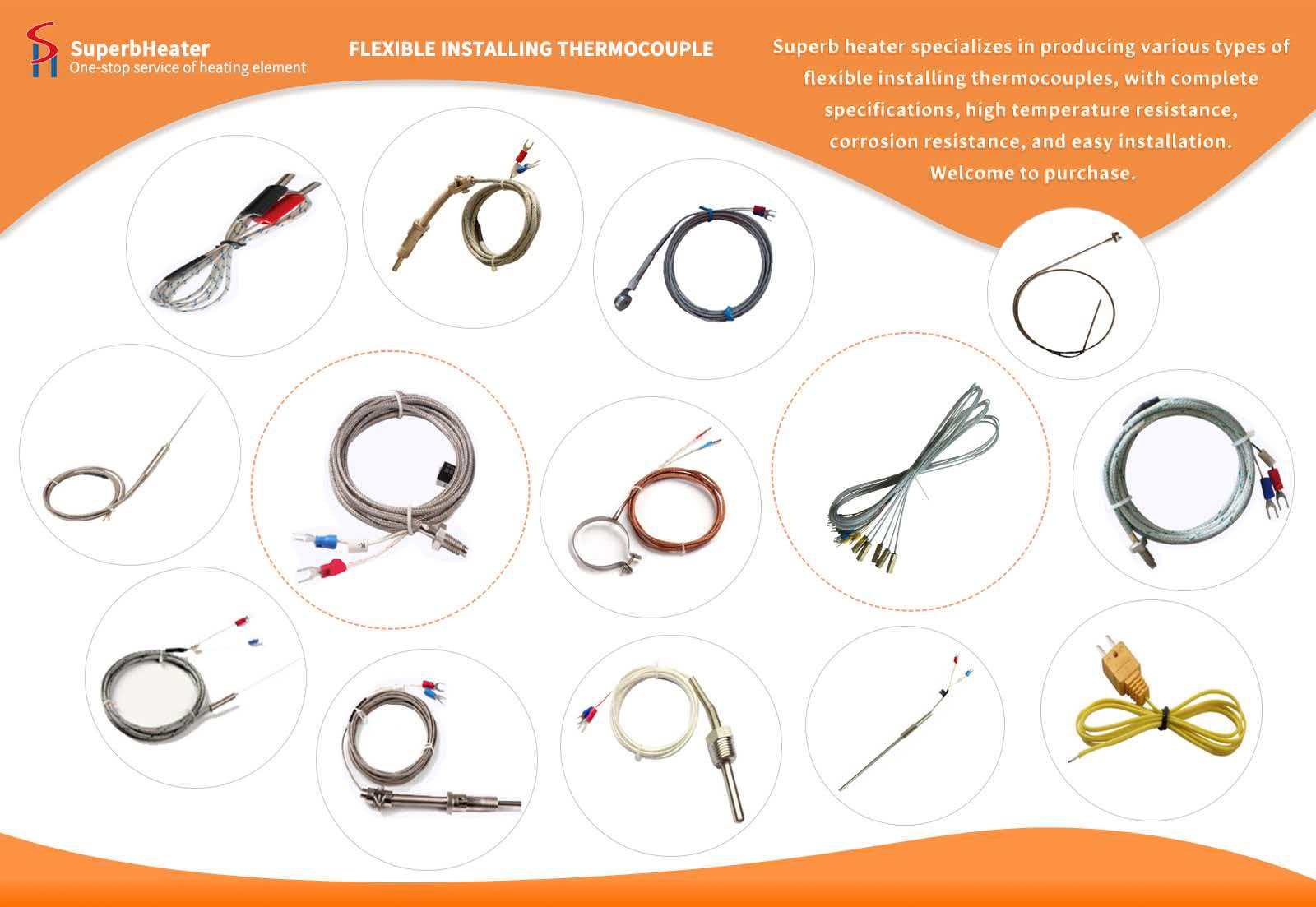
Structural Differences and Installation Methods
Fixed Flange Mounting Type: The probe end integrates a one-piece metal flange (such as a slip-on or weld-neck flange). Bolts pass through the flange holes to rigidly connect to the equipment's flange surface, allowing for through-penetration into the medium and forming a face-seal structure. The protective tube material is typically 304/316L stainless steel or Inconel, suitable for high-pressure, high-temperature fluid environments.
Clamp-on Type: Without a flange or threaded interface, the probe end is embedded in an elastic metal clamp or hoop ring. By tightening the clamp bolts, the probe is pressed tightly against the outer surface of the measured pipe. This is a non-invasive, surface-contact type design, requiring no drilling or welding for installation. Products are often labeled "clamp-on," "hoop type," or "ring type."
Core Performance Parameter Comparison
|
Performance Dimension |
Fixed Flange Mounting Type |
Clamp-on Type (Hose Clamp/Band Clamp) |
|
Mounting Method |
Flange bolts tightened, requires pre-machined flange interface, penetrates the medium |
Clamp ring tightened, fits against the outer surface of the pipe, non-destructive installation |
|
Temperature Measurement Location |
Inside the medium (steam, liquid, gas) |
Outer surface of the equipment (pipes, rollers, barrels) |
|
Temperature Range |
0℃ to 1300℃+ (K-type, S-type, and B-type are all achievable) |
≤760℃ (most products have an upper limit of 600–760℃, limited by clamp material and insulation) |
|
Thermal Response Time |
60–90 seconds (long heat conduction path, large flange heat capacity) |
≤1–10 seconds (direct contact with the outer wall, extremely short heat conduction path) |
|
Sealing Capability |
High sealing performance, can withstand pressures above PN40, conforms to ASME B31.1 standard |
No sealing function, relies solely on contact heat transfer, not leak-proof, not pressure-resistant |
|
Vibration Resistance |
Extremely high, rigid flange connection, strong impact resistance |
Medium, long-term vibration may cause the clamp to loosen, requiring regular inspection of tightening force |
|
Maintenance Convenience |
Disassembly requires loosening all bolts, long downtime, often requires complete replacement |
Can be quickly replaced online, only requires loosening the clamp, no downtime required |
|
Calibratability |
Can be removed for inspection, supports separate calibration |
Not removable, requires complete replacement, calibration relies on replacing the entire unit |
|
Standard Basis |
GB/T 30429-2013, GB/T 9119-2010 |
No national mandatory standard, based on manufacturer's standards and IEC 60584-1 Calibration, a non-standard customized product |
Application Scenarios and Selection Logic
Fixed Flange Type:
Suitable for internal temperature measurement of high-pressure, large-diameter, and high-temperature media: such as petrochemical hydrogenation reactors, nuclear power main steam pipelines, refinery plant outlets, and large boiler flues;
Used for safety interlocks, continuous production, and mandatory calibration points, requiring long-term stability, high sealing, and corrosion resistance;
Typical industries: power, nuclear power, large-scale chemical industry, pharmaceutical CIP main pipelines.
Hose Clamp Type:
Specifically used for surface temperature measurement where drilling is impossible, welding is prohibited, and quick replacement is required: such as injection molding machine nozzles, extruder barrels, reactor outer walls, heat treatment furnace rollers, lithium battery electrode sheet rollers, and water pipe walls;
Suitable for equipment inspection, process temperature difference analysis, and temporary monitoring, requiring fast response, convenient installation, and non-destructive installation;
Product examples: Huanya Thermal Engineering K-type clamp type (0–600℃), Supot Hose Clamp Ring Type (1s response), Siemens QAD series (for water pipe walls), Jingxun Changtong Clamp Type (from 7 yuan).
Selection Mantra:
"To measure the fluid inside the pipe, choose a flange penetration; to quickly measure the outer wall, use a hose clamp."
Consequences of Incorrect Selection:
Using a hose clamp type for the inside of a high-pressure steam pipeline → The probe cannot contact the medium, the reading lags, and temperature measurement fails;
Using a flange type for the outer wall of an injection molding machine nozzle → Requires additional processing of the flange interface, damaging the equipment structure, and doubling the cost.
Installation and Operation Guidelines
Fixed Flange Type:
Before installation, align the flange faces, ensuring parallelism ≤ 0.1 mm/m;
Use a torque wrench to tighten the bolts diagonally and crosswise according to the standard torque (30–50 N·m);
Use metal-wound gaskets or graphite gaskets for sealing; rubber gaskets are prohibited;
After installation, perform an airtightness pressure test, with a pressure ≥ 1.25 times the working pressure.
Hose Clamp Type:
Clean the measured surface, removing oil and oxide layers to ensure direct metal-to-metal contact;
Attach the probe to the surface and tighten the clamp bolts to ensure the probe is evenly pressed (recommended clamping force 5–10 N);
Do not use PTFE tape or adhesives, as they will affect heat conduction;
Check the clamp tightness every two weeks to prevent poor contact due to thermal expansion and contraction;
After long-term use, the clamp may fatigue and needs to be replaced as a whole; it cannot be repaired.
Industry Standards
Fixed Flange Type: Strictly follow GB/T 30429-2013 "Industrial Thermocouples" and GB/T 9119-2010 "Flat and Raised Face Steel Pipe Flanges";
Hose Clamp Type: There are no mandatory national standards. Its structure and performance are internally calibrated by the manufacturer based on IEC 60584-1 (Thermocouple Calibration Tables) and IEC 60584-2 (Tolerances). Product parameters are subject to the manufacturer's technical specifications.