Mold startup is a critical phase where thermocouple readings must be interpreted carefully to avoid damaging the mold or producing defective parts. During the initial heating, the thermocouple reading is the primary indicator of the system's status. The first thing to observe is the rate of temperature rise. A healthy system heats at a consistent rate (e.g., 5-10°C per minute) up to the setpoint. If a zone heats significantly slower than others, it may indicate a heater failure, a thermocouple with poor contact, or a cooling line that is cooling the zone. If a zone heats much faster, it could be a heater shorted to ground or a thermocouple that is loose (measuring air temperature). The second thing to observe is the temperature "plateau." As the hot runner reaches the setpoint, the temperature should stabilize with minimal oscillation. If the temperature overshoots the setpoint by more than 5-10°C before settling, the PID parameters may be too aggressive. This overshoot can degrade heat-sensitive resins. The third thing to observe is the correlation between zones. If the hot runner has multiple zones, they should reach the setpoint within a reasonable time of each other (e.g., within 5 minutes). If a zone is consistently behind, it may have a lower heater power or be affected by a cooling line. The fourth thing to observe is the power percentage of each zone. At the setpoint, the power should be relatively low (e.g., 20-40%). If a zone requires >60% power to maintain the setpoint, it indicates a thermal problem-heat loss to the mold plate or a failing heater. The fifth thing to observe is any unusual behavior: sudden temperature drops (indicating a loose connection), noise (EMI), or a "stuck" reading (the thermocouple may be open). The sixth step is to perform a "bump test." Once the system is stable, deliberately change the setpoint by 5°C and observe the response. The temperature should rise or fall smoothly and settle at the new setpoint within a few minutes. If the response is sluggish or oscillating, the thermocouple may be slow or the PID tuning needs adjustment. The seventh step is to check the calibration. Before starting production, verify the nozzle tip temperature using a pyrometer to ensure it matches the controller reading. By carefully interpreting thermocouple readings during startup, operators can catch potential problems early, prevent material degradation, and ensure that the hot runner is ready for stable production. A startup checklist based on these observations is a valuable tool for ensuring consistency and reliability.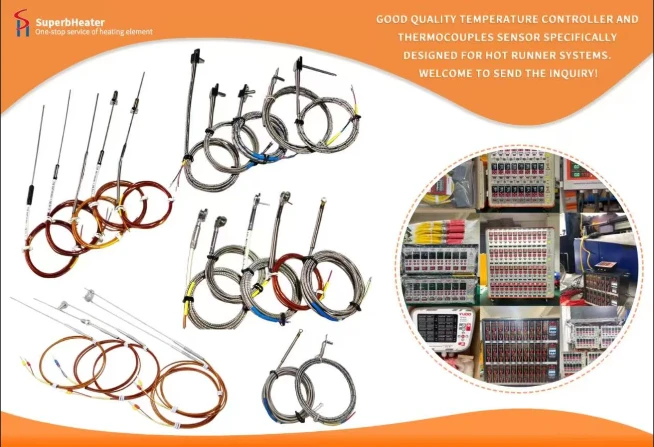

 English
- English
- Français
- Deutsch
- 日本語
- Italiano
- Español
- Português
- русский
- Indonesia
- عربي
- Ελληνικά
- Polski
- فارسی
- עברית
- Kreyòl Ayisyen
- 한국어
- Türkçe
- slovenčina
- Bai Miaowen
- Cymraeg
- dansk
- Lietuvių
- Malti
- Svenska
- Srbija jezik (latinica)
- O'zbek
- ไทย
- suomi
- magyar
- Eesti
- Català
- slovenščina
- Melayu
- Български
- اردو
- România limbi
- bosanski
- हिंदी
- Gaeilgenah Éireann
- Việt Nam
- বাংলা
- íslenska
- Norsk
- Latviešu
- hrvatski
- Nederlands
- Čeština
- українська


