Real-time process correction uses thermocouple data to automatically adjust injection molding parameters during the cycle, compensating for thermal disturbances and ensuring consistent part quality. The first step is to establish a correlation between the thermocouple reading and the part quality. Conduct a designed experiment where the temperature is varied by ±5°C, and the part's weight and dimensions are measured. This yields a mathematical model: e.g., Part Weight = f(Temperature). The second step is to define the correction algorithm. A simple correction is "temperature feedback": if the thermocouple reading deviates from the setpoint by a certain amount, the injection pressure or speed is adjusted in real time. For example, if the temperature rises by 1°C, the injection pressure is reduced by 0.5 MPa to compensate for the lower viscosity. The third step is to integrate the thermocouple data with the machine controller. This requires a communication link between the temperature controller and the machine's PLC. The thermocouple value is sent to the PLC, which runs the correction algorithm. The fourth step is to implement "closed-loop" control. The machine adjusts the injection parameters based on the thermocouple reading, creating a feedback loop. For example, during the injection phase, if the thermocouple reading at the nozzle rises (indicating shear heating), the machine can reduce the injection speed to prevent over-heating. The fifth step is to use "feedforward" control. Based on the thermocouple reading at the start of the cycle, the machine predicts the temperature change that will occur during injection and pre-adjusts the parameters. This is faster than feedback control. The sixth step is to use a model-based control. A mathematical model of the hot runner's thermal behavior is used to predict the temperature at any point, and the control actions are adjusted accordingly. The thermocouple data is used to update the model. The seventh step is to monitor the effectiveness. Track the part weight and dimensions before and after implementing real-time correction. If the variation is reduced, the correction is working. The eighth step is to tune the correction parameters. The gain of the feedback loop must be set correctly; too high and it can cause instability; too low and it is ineffective. Use trial-and-error or a simulation to optimize the gain. By implementing real-time process correction based on thermocouple data, molders can achieve exceptional part consistency, even in the presence of ambient temperature changes, material variations, or other disturbances. This is a key step towards fully automated, zero-defect production.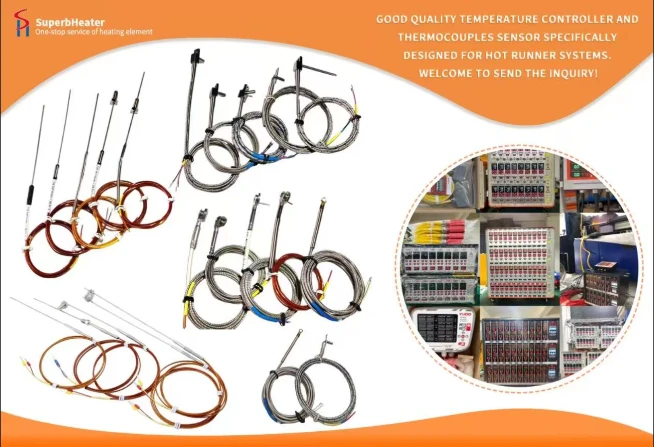

 English
- English
- Français
- Deutsch
- 日本語
- Italiano
- Español
- Português
- русский
- Indonesia
- عربي
- Ελληνικά
- Polski
- فارسی
- עברית
- Kreyòl Ayisyen
- 한국어
- Türkçe
- slovenčina
- Bai Miaowen
- Cymraeg
- dansk
- Lietuvių
- Malti
- Svenska
- Srbija jezik (latinica)
- O'zbek
- ไทย
- suomi
- magyar
- Eesti
- Català
- slovenščina
- Melayu
- Български
- اردو
- România limbi
- bosanski
- हिंदी
- Gaeilgenah Éireann
- Việt Nam
- বাংলা
- íslenska
- Norsk
- Latviešu
- hrvatski
- Nederlands
- Čeština
- українська


