Thermocouple data is not just for controlling temperature-it can also be used to optimize the injection molding cycle time, specifically the cooling time and the gate freeze time. In a typical injection molding cycle, the cooling time often dominates the total cycle time. The cooling time must be sufficient for the part to cool below its ejection temperature, but if it is too long, it wastes time. The thermocouple near the gate can detect when the gate has frozen, which is the moment when the part is sealed and no more material can enter. By monitoring the thermocouple reading at the gate, the controller can determine when the gate has frozen. The gate freeze is often indicated by a sudden temperature increase (or a reduction in the rate of decrease) as the heater compensates for the loss of cooling effect from the flowing melt. Once this point is detected, the controller can signal the machine to start the mold opening sequence, reducing the cooling time to the minimum required. This is called "intelligent cooling" or "gate freeze detection." The second way to optimize cycle time is to analyze the temperature profile of the nozzle. If the nozzle temperature is too high, the gate will freeze later, prolonging the cycle. By lowering the setpoint by a few degrees (while still ensuring fill), the gate freeze time can be shortened. The thermocouple data shows the effect of the setpoint change on the freeze time. The third way is to use the thermocouple to monitor the mold temperature at the cavity surface. While this is typically a separate sensor, the hot runner thermocouple can be used to correlate the mold surface temperature with the hot runner temperature. By establishing a mathematical model, the controller can predict the mold surface temperature from the nozzle temperature, allowing further optimization of the cooling time. The fourth way is to use the thermocouple to detect the "thermal balance" of the mold. If the mold is not properly cooled, the hot runner temperature may drift upward over the cycle. By monitoring this drift, the process engineer can adjust the cooling water flow or the cycle time to restore balance. The fifth way is to use the thermocouple in an "adaptive" cycle. As the mold temperature increases during a long run, the gate freeze time may change. The thermocouple data can feed into a control algorithm that adjusts the cooling time in real time to maintain consistent part quality. By leveraging thermocouple data for cycle time optimization, molders can reduce cycle times by 5-15%, significantly increasing the productivity of the machine. This approach requires a controller with data logging capabilities and an advanced algorithm, but the return on investment is substantial, making it a key focus for high-volume production.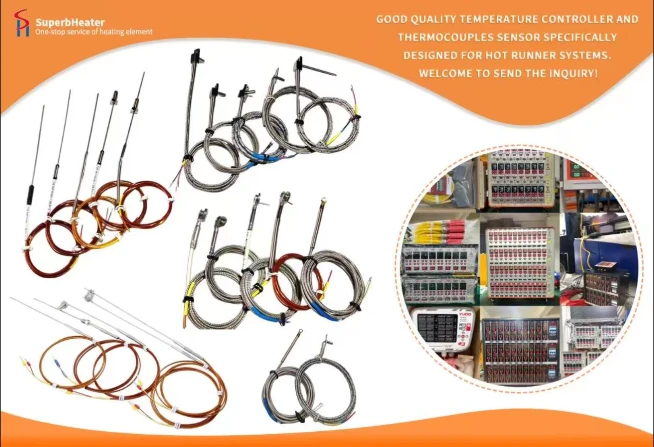

 English
- English
- Français
- Deutsch
- 日本語
- Italiano
- Español
- Português
- русский
- Indonesia
- عربي
- Ελληνικά
- Polski
- فارسی
- עברית
- Kreyòl Ayisyen
- 한국어
- Türkçe
- slovenčina
- Bai Miaowen
- Cymraeg
- dansk
- Lietuvių
- Malti
- Svenska
- Srbija jezik (latinica)
- O'zbek
- ไทย
- suomi
- magyar
- Eesti
- Català
- slovenščina
- Melayu
- Български
- اردو
- România limbi
- bosanski
- हिंदी
- Gaeilgenah Éireann
- Việt Nam
- বাংলা
- íslenska
- Norsk
- Latviešu
- hrvatski
- Nederlands
- Čeština
- українська


