Stack molds, which have two or more parting lines and produce parts from both sides of the machine, present unique challenges for hot runner thermocouples due to their complex mechanical design and thermal conditions. The first challenge is the rotating or moving core plate. In a typical stack mold, the center plate rotates or indexes to transfer the preform or the part. The thermocouple wiring must accommodate this movement. Standard cables will twist and fatigue, causing breaks. To mitigate, use cables with high flexibility, such as those with a spiral wrap or an articulated cable carrier. Some designs use slip rings or inductive couplers to transmit the thermocouple signal across the rotating interface, eliminating moving cables. The second challenge is the limited access for maintenance. The thermocouples are often deep within the stack, making them difficult to reach for inspection or replacement. Therefore, the sensors must be highly reliable, with a design life that matches the mold's overhaul interval. Using premium thermocouples with Inconel sheaths and robust sealing is advisable. The third challenge is the uneven heat distribution. In a stack mold, the center plate is heated from both sides, but the outer plates are heated from one side only. This creates a thermal gradient that the thermocouple must accurately measure. The sensors must be placed to reflect the true temperature of each plate, and the controller must be able to apply different setpoints for each side. This often requires a dedicated thermocouple for each plate. The fourth challenge is the high clamping force. The stack mold is subjected to very high clamping forces to keep the plates sealed. This force can compress the thermocouple if the mounting hole is not designed correctly. The hole must allow the probe to float slightly so that it is not crushed. Spring-loaded designs are essential, but the spring force must be carefully calculated. The fifth challenge is the shear heat generated by the plastic flow. In a stack mold, the melt travels through a long hot runner system, and shear heating can cause temperature increases at the injection unit. The thermocouple at the entrance of the stack may read higher than the melt at the far end. Therefore, thermocouples must be placed along the length of the flow path to detect any temperature rise. The sixth challenge is the increased risk of EMI. With more cables in a confined space, the risk of electrical noise coupling is higher. Use shielded cables and proper segregation. By addressing these challenges, stack molds can achieve stable and consistent temperature control, enabling high-productivity molding of parts like caps, closures, and thin-wall containers.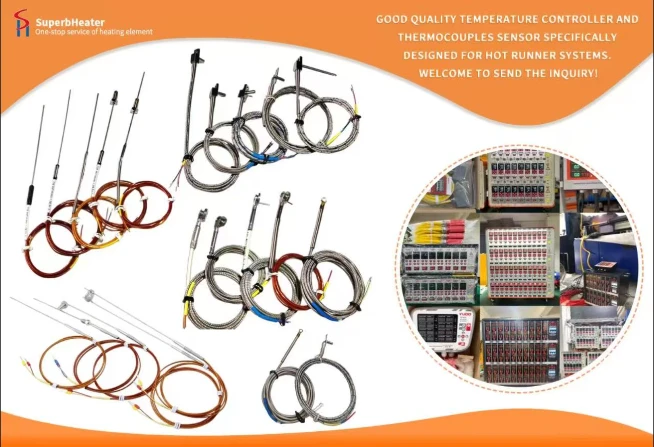

 English
- English
- Français
- Deutsch
- 日本語
- Italiano
- Español
- Português
- русский
- Indonesia
- عربي
- Ελληνικά
- Polski
- فارسی
- עברית
- Kreyòl Ayisyen
- 한국어
- Türkçe
- slovenčina
- Bai Miaowen
- Cymraeg
- dansk
- Lietuvių
- Malti
- Svenska
- Srbija jezik (latinica)
- O'zbek
- ไทย
- suomi
- magyar
- Eesti
- Català
- slovenščina
- Melayu
- Български
- اردو
- România limbi
- bosanski
- हिंदी
- Gaeilgenah Éireann
- Việt Nam
- বাংলা
- íslenska
- Norsk
- Latviešu
- hrvatski
- Nederlands
- Čeština
- українська


