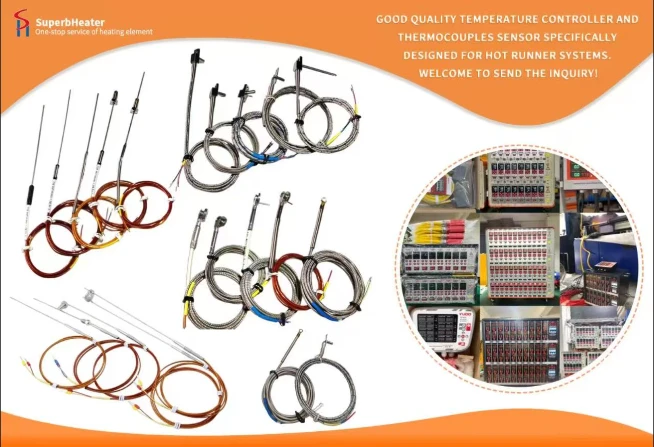
Hot runner thermocouples must comply with various certification standards that ensure quality, safety, interoperability, and reliability. Understanding these standards is essential for procurement, installation, and regulatory compliance in different industries and geographic regions.
Thermocouple Performance Standards
The most fundamental standards are those that define thermocouple material compositions and accuracy classes. IEC 60584 is the international standard for thermocouple calibration, defining the relationship between temperature and electromotive force for all standard thermocouple types. ASTM E230 provides similar specifications for the North American market. These standards define accuracy classes-Class 1 provides ±1.5°C for J-type and ±1.6°C for K-type, while Class 2 provides ±2.5°C for J-type and ±2.2°C for K-type. For medical and automotive applications, Class 1 sensors are typically required.
Insulation Resistance Standards
Mineral-insulated thermocouples must meet insulation resistance standards to ensure signal integrity. IEC 60751 specifies insulation resistance requirements for temperature sensors. Typical requirements are insulation resistance of at least 100MΩ at room temperature, with reduced but acceptable values at elevated temperatures. Sensors meeting these standards provide reliable signal isolation.
Environmental Protection Standards
Ingress Protection (IP) ratings defined in IEC 60529 specify protection against dust and moisture. For hot runner applications, thermocouples installed in mold environments need IP67 (dust-tight and protected against temporary immersion) or IP69 (protection against high-pressure water jets) for wash-down environments. Connectors and cable assemblies must be rated for the industrial environment.
Electromagnetic Compatibility Standards
EMC standards ensure thermocouple signals are not corrupted by electromagnetic interference and do not emit excessive interference. EN 61326-1 specifies EMC requirements for electrical equipment for measurement, control, and laboratory use. Thermocouples with shielded cables and proper grounding meet these standards when installed correctly.
Material Compliance Standards
Materials used in thermocouple construction must comply with substance restrictions. RoHS (Restriction of Hazardous Substances) restricts lead, mercury, cadmium, and other hazardous substances in electronic equipment. REACH (Registration, Evaluation, Authorisation and Restriction of Chemicals) requires compliance for products sold in the European Union. For food contact applications, FDA compliance or EU Regulation 10/2011 may apply.
Industrial Safety Standards
General safety standards apply to thermocouples as electrical components. UL 61010-1 specifies safety requirements for electrical equipment for measurement, control, and laboratory use. CE marking indicates compliance with EU safety, health, and environmental protection requirements. CSA certification is required for Canadian markets.
Medical Device Standards
For medical applications, additional standards apply. ISO 13485 specifies quality management system requirements for medical devices. Thermocouples used in medical molding operations may need to be validated under the device manufacturer's quality system. Traceability to national calibration standards is required.
Automotive Industry Standards
Automotive applications often require compliance with IATF 16949, the automotive quality management system standard. Production part approval process (PPAP) documentation for thermocouples may be required for supplier qualification. Statistical process control (SPC) data for temperature measurement may be part of the manufacturing documentation.
Calibration and Traceability Standards
Thermocouple calibration must be traceable to national standards (NIST in the US, PTB in Germany, NPL in the UK). Calibration certificates should state the uncertainty of measurement and the date of calibration. ISO 17025 accreditation for the calibration laboratory provides independent confirmation of competence.
Importance of Standard Compliance
Selecting thermocouples that comply with relevant standards ensures quality, reduces risk, simplifies regulatory audits, and facilitates international trade. Non-compliant sensors can lead to production problems, rejected parts, and regulatory issues. Always verify standard compliance when procuring thermocouples, and maintain documentation for regulatory review.