Injection molding process validation, as required by ISO 13485 for medical devices and by automotive quality standards, involves three stages: Installation Qualification (IQ), Operational Qualification (OQ), and Performance Qualification (PQ). Thermocouples play a vital role in all three stages. During IQ, the thermocouple installation is verified. This includes checking that the thermocouples are correctly installed in the specified holes, that the connectors are securely attached, and that the wiring follows the routing plan. The thermocouple's calibration certificate is reviewed to ensure it is within tolerance and has traceability to national standards. This step documents that the sensors are installed per the design specification. During OQ, the hot runner's temperature control is challenged. The thermocouples are used to verify that the hot runner can achieve and maintain the required temperature setpoints across the operating range. The typical OQ test involves running the hot runner at low, nominal, and high setpoints (e.g., setpoint ±5°C) and recording the temperature stability over a defined period (e.g., 2 hours). The thermocouple data must show that the temperature stays within the specified tolerance (e.g., ±1°C). This demonstrates that the control system, including the thermocouples, works as intended. During PQ, the thermocouple data is used to validate the actual production process. The temperature of each zone is recorded continuously during production runs, and the data is analyzed for variability. The process capability index (Cpk) is often calculated for the temperature parameter-a Cpk > 1.33 indicates that the process is capable. The thermocouple data is also correlated with part quality data (e.g., weight, dimensions) to demonstrate that the temperature control is effective. For medical devices, the thermocouple data is part of the validation report, and the sensors used must have traceable calibration. If a thermocouple is replaced after validation, a re-validation may be required, unless the replacement is of the exact same type and the controller's offset is verified. To simplify re-validation, some facilities keep a set of "golden" thermocouples that are only used for validation and are never used in production, ensuring their calibration is pristine. By properly integrating thermocouples into the validation process, molders not only meet regulatory requirements but also build a strong process foundation that reduces risk and ensures consistent quality.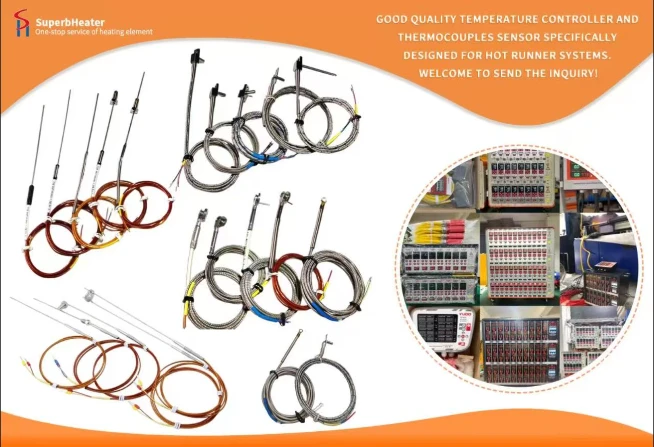

 English
- English
- Français
- Deutsch
- 日本語
- Italiano
- Español
- Português
- русский
- Indonesia
- عربي
- Ελληνικά
- Polski
- فارسی
- עברית
- Kreyòl Ayisyen
- 한국어
- Türkçe
- slovenčina
- Bai Miaowen
- Cymraeg
- dansk
- Lietuvių
- Malti
- Svenska
- Srbija jezik (latinica)
- O'zbek
- ไทย
- suomi
- magyar
- Eesti
- Català
- slovenščina
- Melayu
- Български
- اردو
- România limbi
- bosanski
- हिंदी
- Gaeilgenah Éireann
- Việt Nam
- বাংলা
- íslenska
- Norsk
- Latviešu
- hrvatski
- Nederlands
- Čeština
- українська


