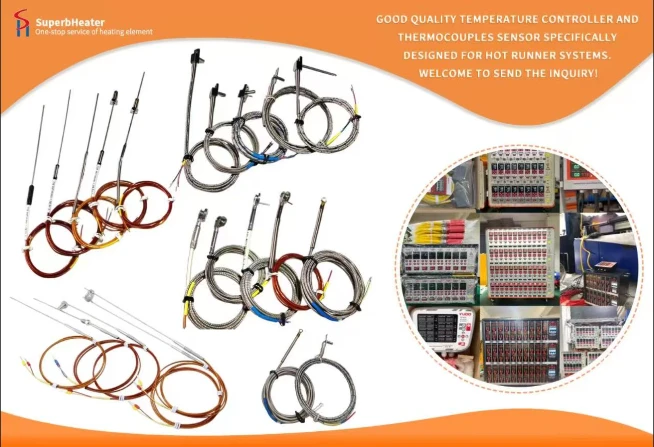
Every hot runner user has seen this: all zones set to the same temperature, but one zone runs noticeably hotter or cooler. The thermocouples read the same setpoint, but the parts tell a different story. There are several reasons for this, and not all of them are thermocouple issues.
The Position Effect
Outer zones lose more heat to the mold plate than inner zones. This is physics. The outer nozzles are closer to the cooled mold, so they have more heat loss. With identical setpoints and identical thermocouple readings, the outer zones are actually cooler at the melt. You need to set them higher to compensate. This isn't a thermocouple problem-it's a thermal design reality.
The Flow Path Effect
In a manifold, the melt doesn't travel equal distances to all cavities. Some cavities get melt that's traveled a short distance; others get melt that's traveled a long distance. The melt cools as it travels, so cavities with longer flow paths get cooler melt. The thermocouple measures the manifold temperature, but the melt temperature at the gate may differ.
The Heater Imbalance Effect
Not all heaters are identical. A heater with slightly lower resistance will draw slightly more current and produce slightly more heat. Over time, heaters degrade at different rates. One zone's heater may be putting out 5% more heat than another zone's heater, even with identical setpoints. The thermocouple reads the temperature, but the actual heat input differs.
The Thermocouple Placement Effect
Thermocouples are not always placed identically from zone to zone. One sensor might be closer to the heater, another closer to the gate. These placement differences affect what temperature the sensor reads. Identical setpoints don't mean identical thermal conditions.
The Insulation Effect
Some zones have better insulation than others. Heat loss to the mold plate depends on how much steel is around the nozzle, how the cooling channels are arranged, and how the mold is designed. Identical zones on the same mold can have different heat loss profiles.
Compensation Strategy
The solution is to set different setpoints for different zones. The thermocouples are reading correctly-the thermal environment is just different. Use a thermal profile to determine the offset needed for each zone. This is normal, not a sign of thermocouple problems.
The Calibration Check
If you suspect thermocouple calibration differences, swap thermocouples between zones. If the "hot" zone becomes "cold," the sensor is the issue. If the zone stays different, the thermal environment is the issue. This is a quick diagnostic.