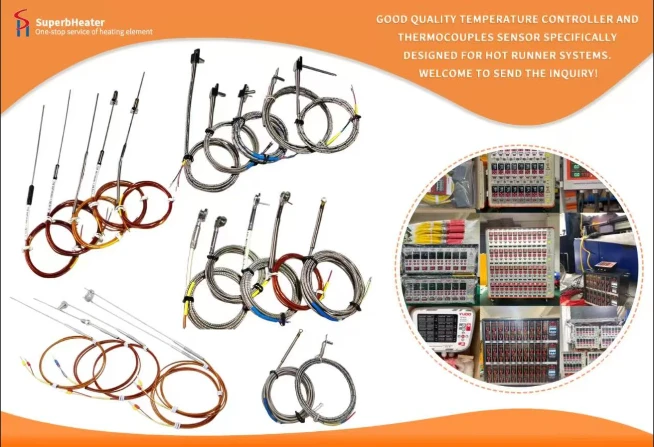
Nozzle thermocouple integration is a critical design aspect that directly affects temperature control accuracy, heater life, and mold reliability. Several key design factors must be considered when integrating thermocouples into hot runner nozzles.
Positioning Relative to Heater
The thermocouple must be positioned optimally relative to the heater element to measure temperature accurately. Ideally, it should be located between the heater and the melt channel, not on the heater side (which measures heater temperature, not melt temperature) nor on the outer surface (which measures mold temperature). A position that balances both heat input and heat loss is ideal.
Insertion Depth
Insertion depth determines how accurately the thermocouple measures the temperature of interest. Too shallow a depth measures mold plate temperature rather than nozzle temperature. Too deep may position the sensing junction too close to the heater, causing oversensitivity. A depth of about 1mm from the heater side or 2–3mm from the outer surface is typical, but optimized designs use finite element analysis to determine the optimal position.
Mechanical Retention
The thermocouple must be securely retained to maintain consistent contact with the nozzle surface. Retention mechanisms include compression fittings, spring-loaded hold-down devices, and adhesive bonding (less common for high-temperature). Spring-loaded designs accommodate thermal expansion while maintaining contact pressure. Threaded retention must account for thermal cycling that can loosen threads.
Cable Egress and Routing
Cable egress design impacts routing, strain relief, and reliability. Cables should exit the nozzle in a direction that minimizes bending and twisting. Strain relief mechanisms at the exit point prevent cable damage from mold movement. Routing paths should avoid pinch points between nozzle and mold plate.
Thermal Isolation from Surroundings
Thermocouple design must isolate the sensing junction from surrounding temperatures to ensure it measures only the nozzle temperature. Insulating bushings or air gaps around the sensor body reduce heat conduction from the nozzle to the mold plate. Insulation materials must withstand operating temperature without degradation.
Easy Serviceability
Design should facilitate thermocouple replacement without complete nozzle disassembly. Accessible connectors or quick-disconnect fittings enable fast changeovers. Standardization of thermocouple types and connector styles across molds simplifies spare parts management.
Protection from Mechanical Damage
The thermocouple must be protected from mechanical damage during mold assembly, operation, and maintenance. Shielded sheaths, protective covers, and routing in protected channels reduce damage risk. Robust construction with thicker sheaths at exposed points improves durability.
Impact on Nozzle Thermal Profile
The thermocouple's presence affects the local thermal profile by acting as a heat sink or insulating element. The sheath conducts heat away from the nozzle, creating a localized cold spot. Proper design minimizes this effect through insulating sleeves or by positioning the sensor in areas where temperature variations are least critical.
Integration with Multi-Zone Nozzles
In multi-zone nozzles with separate heating zones, thermocouples must be assigned to specific zones. Zone partitioning with insulating gaps or sections ensures each zone's thermocouple measures only that zone's temperature. Precision design achieves zone separation with minimal thermal cross-talk.
High Reliability Design
Nozzle thermocouples operate in the harshest conditions-highest temperatures, most thermal cycling, and most mechanical stress. High reliability design features include robust sheath materials (Inconel, stainless steel), high-purity magnesium oxide insulation, and positive locking connectors. Quality verification through accelerated life testing ensures design adequacy.